- AI
- ambiguity
- APIs
- architecture
- augmented reality
- books
- bureaucracy
- career
- change
- Christmas
- cloud
- collaboration
- communication
- complexity
- computer history
- corporate life
- data
- decisions
- delivery
- devops
- end user tools
- ethics
- failure
- fear
- fundamentals
- gaming
- government
- halloween
- history
- humans
- hype
- identity
- infrastructure
- innovation
- language
- leadership
- learning
- legacy
- management
- measurement
- mental health
- money
- networking
- New Year
- operations
- partnership
- philosophy
- physics
- platforms
- prediction
- process
- procurement
- programming
- quantum
- reliability
- resilience
- risk
- science
- science fiction
- security
- shadow IT
- space
- standards
- strategy
- teaching
- teams
- technical debt
- technology advocacy
- testing
- thinking
- transformation
- TV
- virtues
- vision
- writing

A question of identity
It happens in the blink of an eye. You press the tip of your finger against your phone. A capacitative sensor determines the pattern of ridges and valleys in your fingeprint . An algorithm matches the pattern against a digital representation stored in a secure enclave on your mobile device. If it finds a match, it unlocks your phone (or does whatever other task you were attempting to authorise).
There are other means of authentication, such as facial recognition, PIN codes and passwords, but I think that fingerprint recognition is particularly interesting because it illustrates important differences between the ways that humans and machines and systems deal with identity. (By ‘systems’ I mean all formal, process driven methods of interaction - not just those implemented in software on computers.)
When humans think about identity we think about an individual, a person. When we say that we know someone, we mean that we know many things about them: not just their name and their profession, but aspects of their behaviour and personality. It is remarkable how quickly we form an impression of a person: even if we have only shaken hands and shared a meeting room with someone for an hour or two, we come away with some idea of what they are like. (Of course, our impressions are also subject to bias and preconceptions: the speed with which we form ideas about others is not always a good thing.) When we encounter that person again, we don’t typically feel that they need to prove their identity. We recognise them.

It is in the nature of software to be broken
‘Why don’t they just write the code properly? Why can’t they just get it right first time?’
I’ve heard these sentences spoken several times in a professional context by non-technical project managers wondering why the testing phase of a project (or a sprint, or a release) is taking so long.
Even if you’re not a project manager working on a development project, you may have similar questions when you encounter software problems in your normal daily life. Why does your laptop always need updates? Why is the web site you want to use down yet again? Why are big budget games full of bugs when they are first released?
If you have ever written code for a living you may be simultaneously exasperated and embarrassed by these reactions. Embarrassed because you recognise that too much code which makes it to production contains too many bugs which should have been detected and eliminated in testing. Exasperated because comments such as ‘Why don’t they just get it right first time?’ fundamentally misrepresent the experience of writing software.
The round trip question: if you want to understand the world, learn to code
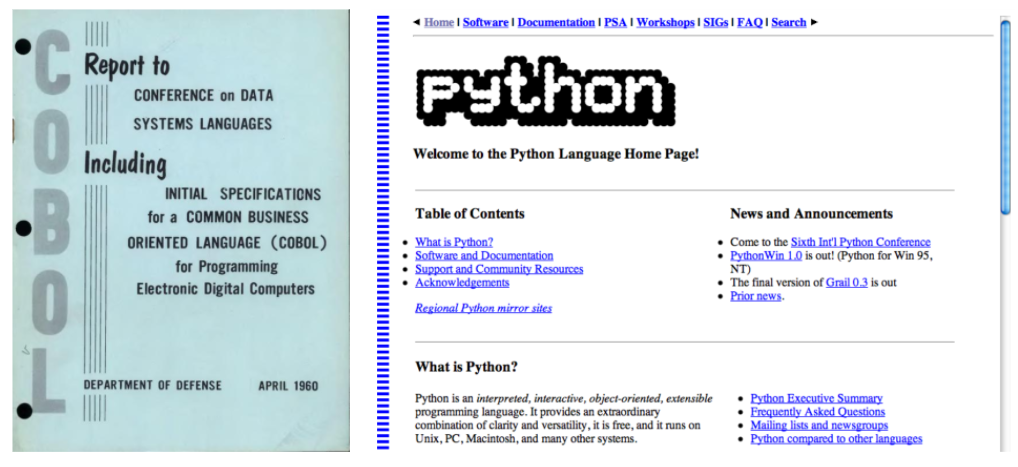
COBOL turned 60 in 2019. Happy birthday COBOL! Python turned 30 this year. Happy birthday Python!
If you work in a large company, you have probably heard of COBOL - often in hushed tones, referring to ancient, giant systems that are held in a special facility somewhere out of sight, tended to by people steeped in ancient wisdom. You may also have heard people speak about Python, often in excited tones, referring to new disciplines such as data science and machine learning, exercised by smart new people fresh out of college.
The comparative age of COBOL and Python may be surprising to anyone who has never had the chance to write code: COBOL is older than Python, but they are both so old that they have been around longer than most people today have been working. If you do write code then you know that, while they may have significant differences, at root these languages are more similar than they are different. They both use the same logical constructs to manipulate data.

The round trip question: what is a computer?
It is the secret that everybody knows: a story which has rightly become a legend. During the Second World War, Alan Turing and a team at Bletchley Park invented the computer in order to crack the Enigma code, shortening the war and saving millions of lives. Turing was persecuted for his sexuality and died tragically, to be recognised as a national hero decades later.
Except that, while Turing deserves all the acclaim we can give him, part of this story is wrong. Turing did not invent the computer to crack the Enigma code. The difference between the device used for Enigma, the Bombe, and the real first computer, Colossus, as well as the original thinking that Turing did before the war, help us understand what makes a computer a computer, and why they make such a difference to the world.

The round trip question: a tale of two computers
Let’s start with a problem. You think some bills have just been paid out of your account. You want to check how much money you have left. You have a computer in your hand - your mobile phone - but that computer does not currently know your balance. There is at least one computer that does know your balance, but it does not belong to you, and it sits in a large building hundreds of miles away. How does the number that represents your balance get from your bank’s computer to the mobile phone in your hand?
This is one of a series of articles which explores how we use computers to run the world by considering the round trip question: what happens when we press a button on a mobile banking app which tells it to do something with our money?
Simply by virtue of being computers, the phone in your hand and the machine in your bank have a lot of similarities. For now, though, I’d like to explore their differences, as those differences are what makes the round trip question interesting.

The round trip question: a duty to explain
Something has been bothering me: I have been designing, building and running computer systems for over thirty years, and believe that the explosive growth of information technology in that time is a net good for the world. At the same time, I have observed a growing gap in understanding between the people who build and run technology for a living and the people who use it. Information technology touches more people’s lives more deeply every day - yet is increasingly difficult to understand.
I sometimes test this feeling by asking what I call ‘the round trip question’. The question is: when you hit a button on your mobile banking app which tells it to do something (get your balance, make a payment, or some other function), what do you imagine happens? (It doesn’t have to be banking, but it’s the industry I happen to have worked in for longest.)

Use both feet to step on to the cloud
The early days of Cloud adoption in many large companies are dominated by the creation of Landing Zones (LZs). This term can mean a lot of things, but encapsulates the set of configuration, controls and instrumentation a company uses to set up a Cloud platform to its liking and needs. If a Cloud platform is like an apartment block, setting up your LZs is like moving your furniture in, putting the locks on the doors and arranging your utilities. You may have people to help you (integrators and consultants in the Cloud, moving companies and interior designers for your apartment), but you are the one who is going to live there.
Many companies struggle in this early stage, as it can feel like they are making their most important decisions at the time they have the least expertise. I have seen this lead to two anti-patterns: the free-for-all and the gold-plated LZ.

Who are you optimising for?
A long time ago, one of my colleagues gave me a reality check. I was working as an architect and he was working as a methods specialist. I thought that our jobs were important, but he reminded me what was really important when he said, ‘We’re here to deliver working software. If we’re not doing that directly, we have to ask whether we’re doing our best for the people who do deliver working software.’
A few months ago, I wrote an article which asked the question, ‘what are you optimising for?’ when attempting Cloud transformation. Today I’d like to ask a question which I think is even more important: ‘who are you optimising for?’

Architecture year one: measuring success
I have a flippant answer when asked how to measure the success of an architecture team: just check how often your phone is ringing. (I realise that this dates my advice - please substitute ringing phones for the messaging app of your choice.) If you and your team are in demand, if you are the first call whenever your company faces a big challenge or opportunity, then you are doing something right. If your phone (or messaging app) is silent, if you have to push to insert yourself into the room with tough problems, then you have more work to do.
However, recently I was talking to a friend and colleague who has just taken on a Chief Architect role in a new company, and who is attempting to design measures of success for their team. In that conversation, I realised that we needed to come up with something a bit more sophisticated than the number of messages on your phone.

To hire and retain software engineers (and other great technologists): your first steps should be trust and value
Many traditional companies are asking the same questions. Why can’t I hire the software engineers (and other talented technologists) I need? Why don’t they stay? Why do my best people keep leaving once I’ve trained them?
There are a lot of obvious answers to these questions. Talented technologists are in demand by traditional companies and digital natives. Traditional companies are often perceived to lack the brand, mission and feeling of excitement that newer companies have. Newer companies may have different compensation structures.
I believe that these reasons are largely valid. However, I think that there is a deeper reason that is more important: many traditional companies have not yet learnt to truly value and trust their technologists. And I believe that this reason is rooted in the history of how technology functions have evolved in large, traditional companies.

Planning for the future: taking the science fictional view
In 1978, Isaac Asimov wrote in his essay My Own View, ‘No sensible decision can be made any longer without taking into account not only the world as it is, but the world as it will be. This, in turn, means that our statesmen, our businessmen, our every man must take on a science fictional way of thinking.’ Reading this in 2021, this quote is both relevant and an example of the short term thinking it warns against: apparently, taking a science fictional view in 1978 didn’t include a world run by anybody but men.
The circumstances in which I came across this quote further illustrated the importance of taking on a science fictional view. I was reading a book on AI ethics, addressing the implications of living in a world where artificial intelligence is already woven into many aspects of our lives, where we contemplate giving AI agents responsibility for life and death decisions in industries such as transport, and where there seems a strong chance that, within our lifetimes, AI agents will exhibit properties which lead us to hard questions about rights and consciousness. Moreover, I was reading the book on a device that fit in the palm of my hand, connected to a global network that gave me access to the world’s knowledge - as well as playing videos and letting me talk to people. A long way from 1978, and not just in social attitudes.

When evaluating startups, evaluate yourself. Will you be a good customer?
Last week, I was privileged to support the annual Female Fintech Founder competition run jointly by Google, Deutsche Bank and Atos. The competition seeks to find the most promising early stage fintech companies founded by women, and to provide the winners with support for the next stage of their success. (And to provide all the participants with advice and networking opportunities.)
At the heart of the session I attended was a great presentation by my colleague Prue MacKenzie. You can read more about that here.
I can’t improve on Prue’s advice, but the session did prompt me to think about how established companies work with new companies, and whether they always get it right. Many of the founders taking part in the competition will offer their services directly to consumers, but many will have corporates as customers or partners. Founding a company takes great courage, especially in times of great uncertainty. Whether they win the competition or not, all of the founders have already taken a greater risk than any I have ever taken in my career. I think that they deserve customers and partners who think deeply about how to work with them.