- agents
- AI
- APIs
- architecture
- augmented reality
- books
- bureaucracy
- career
- change
- Christmas
- cloud
- collaboration
- communication
- complexity
- computer history
- corporate life
- data
- decisions
- delivery
- devops
- end user tools
- ethics
- failure
- fear
- fundamentals
- gaming
- government
- history
- humans
- hype
- identity
- infrastructure
- innovation
- language
- leadership
- learning
- legacy
- management
- measurement
- mental health
- money
- networking
- New Year
- operations
- partnership
- philosophy
- physics
- platforms
- prediction
- process
- procurement
- programming
- quantum
- reliability
- resilience
- risk
- robotics
- science
- science fiction
- security
- shadow IT
- space
- standards
- strategy
- teaching
- teams
- technical debt
- technology advocacy
- testing
- thinking
- transformation
- TV
- virtues
- vision
- writing

A suggested New Year’s resolution: be more curious
When I was growing up, my Dad and my uncles were always working on cars and motorbikes. This was partly through need: they didn’t have much money and they had to travel for work, studies and family life, so fixing a car using spare parts, ingenuity and improvisation was an essential skill. They also enjoyed it: it was as much of a hobby as a necessity.
It was not a practice I ever acquired the skill or the appetite for. I was much more interested in reading books than getting my hands covered in grease and oil. I enjoyed spending time with my Dad and Uncles as they struggled to fit strange shaped pieces of metal into strange shaped spaces, and as they scoured scrap yards to find an old car with the right part. But I never really understood what they were doing.

On the 2025 to-do list: figure out AI agents
Recent years have seen waves of AI innovation breaking faster than we can figure out good practice. Organisations around the world are working hard, not only to find ways to put AI to work, but to do so safely and responsibly. The AI to-do list often seems to be growing longer faster than we can strike items off it - but the only route to good practice is practice.
The advent of AI agents promises to add more items to the to-do list. The AI agent wave started cresting in 2024, and will break in 2025. Several major technology vendors and platforms already offer their customers the ability to build, configure and operate AI agents in an enterprise context, and the ability for consumers to build agents or to subscribe to existing agents, cannot be far behind (indeed, it is likely that, by the time this article is published, it will already be happening).
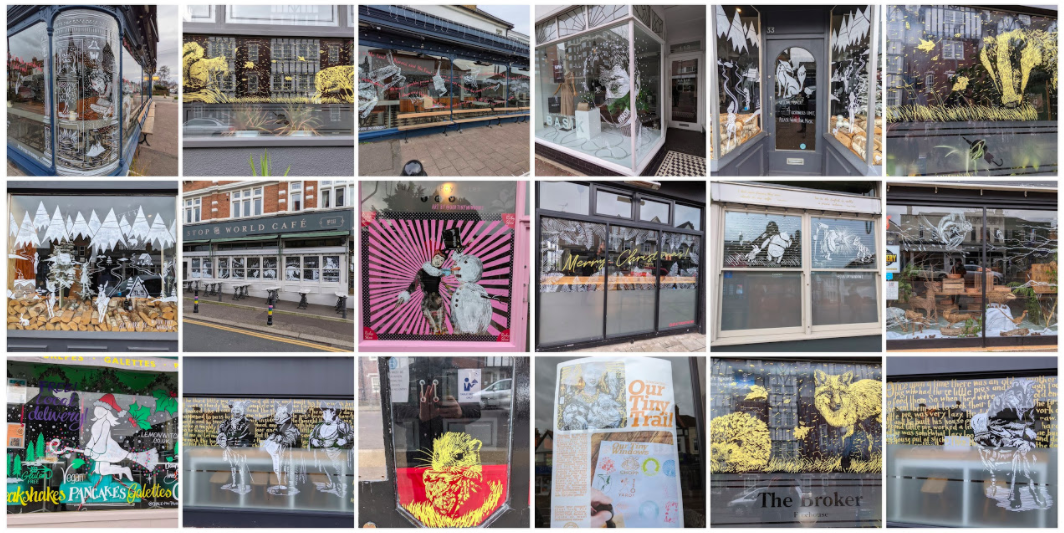
Celebrating our celebrations
If you celebrate Christmas, when did you put up your decorations this year?
In our house, we don’t normally put our decorations up for very long: about a week or so each side of Christmas. But this is not a normal year: we put our decorations up a week early, and I think that many other people did the same. This year (if you live in the Northern Hemisphere) it felt like we needed those extra lights in the darkest time of the year. Even though the timing might have been a break with tradition, it felt important that we could still keep some traditions in some form, despite the challenges we face together.
The value of decoration was brought home to me even more this year by the extra effort made by the shops in the town where I live. For the past few years, many of these shops have had their windows painted by a handful of local companies, but this year even more seemed to join in. The picture at the top of this article shows just some of these paintings.

New Year’s resolution day two: suggestions for making your documents better
Last week I suggested a New Year’s resolution for technology architects: to improve how we present and format documents. I suggested this not just because I am pernickety about document formatting (I am), but because good formatting makes our ideas easier to understand, helps those ideas compete on a level playing field with others, and express our identity as professionals who care.
On the dangerous assumptions that that, first, you were persuaded by this blog post, and, second, that you are interested in keeping this resolution beyond 2nd January, here are a few further suggestions from me on how to put it into practice. As ever, these suggestions come with the caveats that they work for me, but may not work for you, and that I am frequently wrong.

A suggested New Year’s resolution: don’t let bad formatting hide good ideas
My parents gave me many gifts: a loving home and all the support I could ask for. There is one gift, though, which they didn’t plan: a low tolerance for poorly formatted documents, to an extent which has enabled me to irritate every team which has ever worked for me throughout my career.
This started back in the 1980s, when my Dad, who sold print and reprographic equipment, had two realisations. First, he spotted that the shift from hot metal (blocks of lead type set by hand) to phototypesetting (photographic images of type produced electronically) was an inevitable trend. Second, he realised that he’d far rather work for himself than for an employer. As a result he and my Mum founded a typesetting company based out of our home.
Growing up in the same house as my Mum and Dad’s typesetting business taught me many things. It showed me the evolution of a business through technology: as the years passed, I saw the equipment change from its original incarnation (an electric typewriter with an interchangeable ‘golf ball’ for different fonts, to produce paper copy physically cut and paste with scalpels and glue on a light table) through our first proper computers (green screens attached to big orange boxes, which still produced paper for the light table) to its first fully electronic form (Macs with giant screens that produced files(. I also saw the impact on businesses and ways of working: how the flow of motorbike couriers to pick up copy at any time of day and night (print was always a deadline driven business) slowed and stopped as they were replaced by file transfer and email (but still at any time of day or night).

New Year’s resolutions won’t fix bad code
This is the time of year when many of us start planning New Year’s resolutions.
We feel that we could lose some weight, we could be fitter, and we could do more to improve ourselves. A few days of idleness and indulgence has made us feel restless, a little more guilty than usual, and ready for a change. The turning of the year feels like the right time to make that change.
So we make vows that this time - this time - we will change our ways. We will join that gym, enter that diet programme or enrol in that course.
The only problem is that New Year’s resolutions don’t usually work. There’s been lots of research done about why they don’t work, and how we can make them more effective (for example, Richard Wiseman’s Quirkology site has a characteristically interesting and entertaining article: http://www.richardwiseman.com/quirkology/new/USA/Experiment_resolution.shtml). However, while this research can be helpful, we don’t really need it to tell us that New Year’s resolutions don’t usually work: we’ve always known that. New Year’s resolutions are often the punchline to a bad joke, a list of things that we know that we won’t be doing by February.