- agents
- AI
- APIs
- architecture
- augmented reality
- books
- bureaucracy
- career
- change
- Christmas
- cloud
- collaboration
- communication
- complexity
- computer history
- corporate life
- data
- decisions
- delivery
- devops
- end user tools
- ethics
- failure
- fear
- fundamentals
- gaming
- government
- history
- humans
- hype
- identity
- infrastructure
- innovation
- language
- leadership
- learning
- legacy
- management
- measurement
- mental health
- money
- networking
- New Year
- operations
- partnership
- philosophy
- physics
- platforms
- prediction
- process
- procurement
- programming
- quantum
- reliability
- resilience
- risk
- robotics
- science
- science fiction
- security
- shadow IT
- space
- standards
- strategy
- teaching
- teams
- technical debt
- technology advocacy
- testing
- thinking
- transformation
- TV
- virtues
- vision
- writing

Your Moonshot doesn’t have to be a Moonshot
In 1962, NASA faced a difficult technology procurement choice.
They needed a guidance computer for the Apollo Moon missions. Did they go for a design based on new technology, working with researchers at MIT, or a design based on proven technology from their existing suppliers?
They chose the new technology: rather than discrete electronic transistors, they would use silicon chips, which combined multiple transistors into a single component. These chips weren’t like the chips of today, though: rather than millions or billions of transistors, they contained just a few transistors, each representing a single logic gate. Thousands of them were needed to build the Apollo Guidance Computer (AGC).

Who puts the V in your MVP?
We’ve been doing it since before the beginning.
In 1943 Donald Michie and Jack Good were working at Bletchley Park on a machine known as the Heath Robinson, after the cartoonist who drew outlandish contraptions. They were attempting to break the Lorenz cypher used by the German high command, an even greater challenge than the Enigma cypher broken by the team which included Alan Turing.
The machine was known as a Heath Robinson because of its complex and unlikely appearance: paper tapes running at high speed around an apparatus called a ‘bedstead’, connected to a maze of wires, mechanical relays and, crucially, a few electronic valves. Getting the Heath Robinson to work reliably was an enormous challenge - such a challenge that it led to the creation of the Colossus, the first digital computer, by Tommy Flowers and team.
Innovation and application
A couple of months ago, I wrote about the book The Elements of Computing Systems, by Noam Nisan and Shimon Schocken, and how it was helping me traverse the layers of abstraction out of which computing is constructed. After many hours of reading, thinking and programming, I am nearing the end, and was struck by a few sentences in the penultimate chapter which are worth quoting in full:
Modern high-level programming languages are rich and powerful. They allow defining and using elaborate abstractions like functions and objects, expressing algorithms using elegant statements, and building data structures of unlimited complexity. In contrast, the hardware platforms on which the programs ultimately run are spartan and minimal.
At a time when Moore’s law has been running for decades, when semiconductor manufacture is an industry of global significance, and when ever more specialised chips are being produced to optimise the performance of artificial intelligence models, it’s easy to forget that, at root, all this silicon is, as Nisan and Schocken say, ‘spartan and minimal’. However we arrange them, the atomic units of computing remain ones and zeroes. (Let’s leave quantum computing to one side for a moment.)

Through the innovation window
Last week I had the chance to look through a historical pane of glass.
I was visiting Lacock Abbey, the place where Henry Fox Talbot took the first ever photographic negative image in 1835, of a window with latticed leading.
It was a strange feeling, looking through the window which had produced such a significant image. I spent a few moments in reflection, imagining what Fox Talbot must have felt when he first realized that his experiment had worked. Then I took a picture on my phone.
I believe that this historical moment reinforces three important lessons for technologists and innovators today.

Tinker, tailor, strategist, innovator
What do you want to be when you grow up?
I’m still not entirely sure that I know, so it’s slightly scary when people ask for my advice on their career choices. Fortunately, being a technology architect means that I’m always prepared to express an opinion on something I don’t completely understand.
Two of the career choices I am asked about most frequently are technology strategy and innovation (probably because I have people that do both of these types of work in my team). Here is some of the advice I offer people to help them figure out whether these choices are good for them, and what kind of qualities they need to do this work well. (Like all advice from a technology architect it is well meant, but possibly wrong.)

Innovation needs light bulbs . . . and lenses
Thomas Edison didn’t invent the light bulb, but he made affordable, long lasting electric light a reality. And this wasn’t just because he was struck by a sudden inspiration (a light bulb going off over his head): it was because because of disciplined experimentation coupled with a commitment to industrialisation. Most people know that Edison worked his way through thousands of designs for bulbs before patenting a bulb with a carbon filament, and that, even after filing his patent, he worked through thousands more choices for the material that would provide the carbon filament, finally settling on bamboo. It is less frequently mentioned that Edison and the workers at this lab also invented much of the equipment necessary to produce bulbs at scale, as well as the infrastructure needed to distribute power.
Edison himself said of this endeavour that, ‘There was no precedent for such a thing, and nowhere in the world could we purchase these parts. It was necessary to invent everything: dynamos, regulators, meters, switches, fuses, fixtures, underground conductors with their necessary connecting boxes, and a host of other detail parts, even down to insulating tape.’

Innovation needs light bulbs . . . and lenses
Thomas Edison didn’t invent the light bulb, but he made affordable, long lasting electric light a reality. And this wasn’t just because he was struck by a sudden inspiration (a light bulb going off over his head): it was because because of disciplined experimentation coupled with a commitment to industrialisation. Most people know that Edison worked his way through thousands of designs for bulbs before patenting a bulb with a carbon filament, and that, even after filing his patent, he worked through thousands more choices for the material that would provide the carbon filament, finally settling on bamboo. It is less frequently mentioned that Edison and the workers at this lab also invented much of the equipment necessary to produce bulbs at scale, as well as the infrastructure needed to distribute power.
Edison himself said of this endeavour that, ‘There was no precedent for such a thing, and nowhere in the world could we purchase these parts. It was necessary to invent everything: dynamos, regulators, meters, switches, fuses, fixtures, underground conductors with their necessary connecting boxes, and a host of other detail parts, even down to insulating tape.’
The biggest step is from zero to one
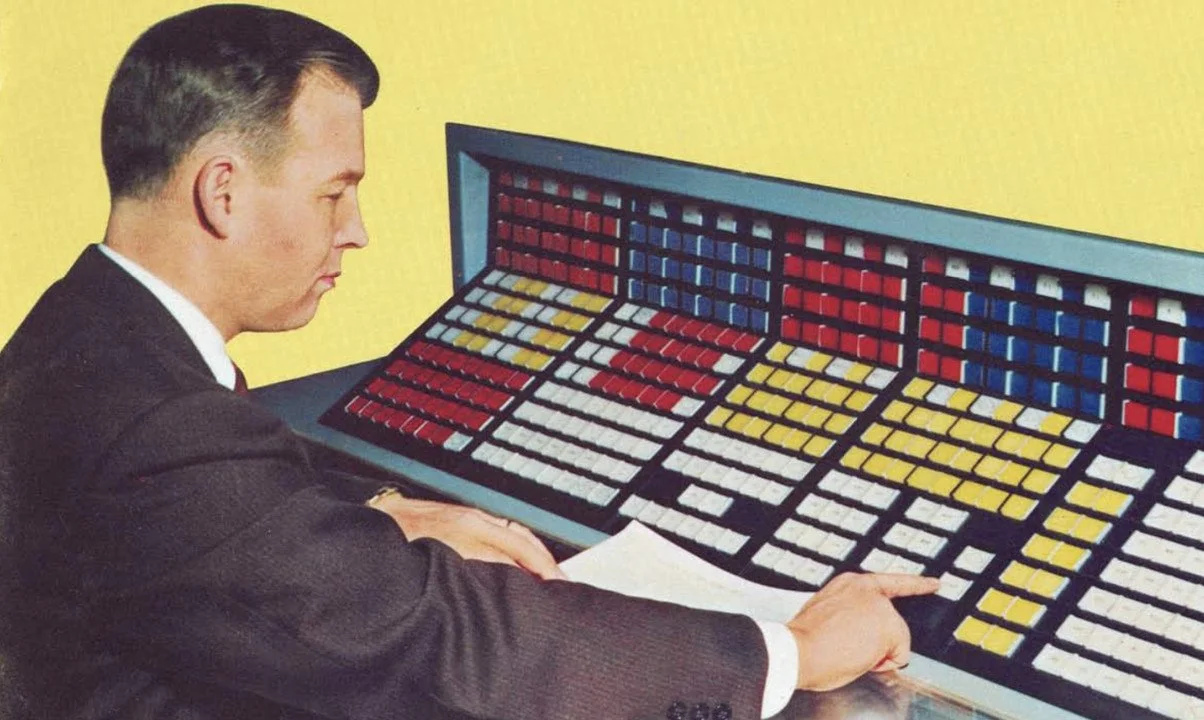
This week I visited our Griffin House office in Sheffield for the last time, before we complete the move to our fantastic new Grosvenor House office a short distance away. The place was part way through packing. Amongst the crates and unplugged machinery, I discovered a print of an article which I guess is from the early 1980s, entitled ‘Into the computer age’and subtitled, ‘Hard on the heels of the Bank’s mechanisation programme came the first commercially viable computers, big enough to fill a room and as mysterious as the switches and dials of Flash Gordon’s space rocket.’
The article lovingly described the purchase of HSBC’s first ever computer in 1961, the English Electric KDP10 (which it turns out, sadly, was not actually a British computer, but a rebadged RCA501 from the USA - computer historians feel free to correct me in the comments), the selection and training of the ‘Magnificent Seven’, the first members of the nascent IT department, and the system of collecting paper tape from machines in branches and shipping them to the computer to be processed.
Beware the SMAC trap
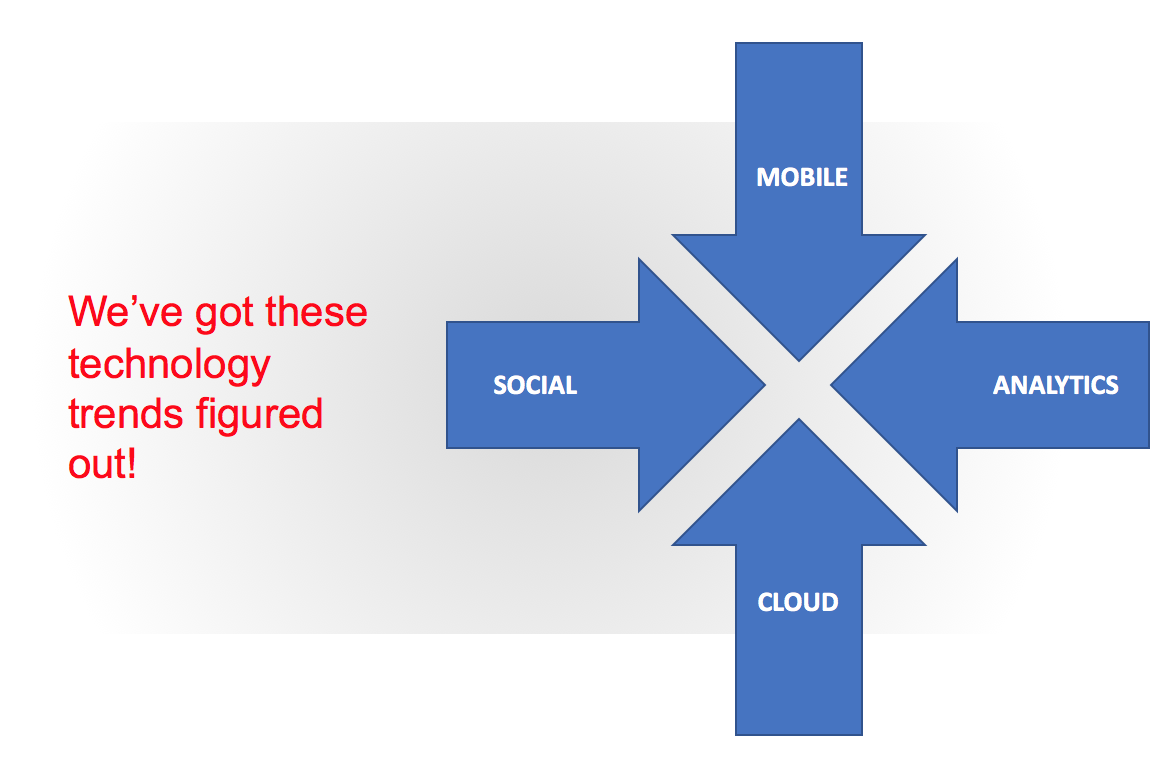
Terms such as SMAC are a tool and a trap.
SMAC stands for Social, Mobile, Analytics and Cloud. It seems to have been coined sometime between 2010 and 2012, but it’s difficult to find its first usage. The idea behind SMAC seems to have come from Gartner’s research on what they call ‘the Nexus of Forces’, although that research talks about Mobile, Social, Cloud and Information (I guess that SMAC is more catchy than MSCI).
The idea behind the term is useful: there are technology trends which are reshaping our world and our businesses, and these trends amplify each other rather than acting in isolation. For example: social media provides new ways for us to connect and communicate; social media on mobile makes it ubiquitous; analytics applied to social media on mobile gives unparalleled insight into our behaviour and preferences; and Cloud provides the storage and compute capacity required to run an analytics driven social network accessed continuously through mobile devices.