The round trip question: a tale of two computers
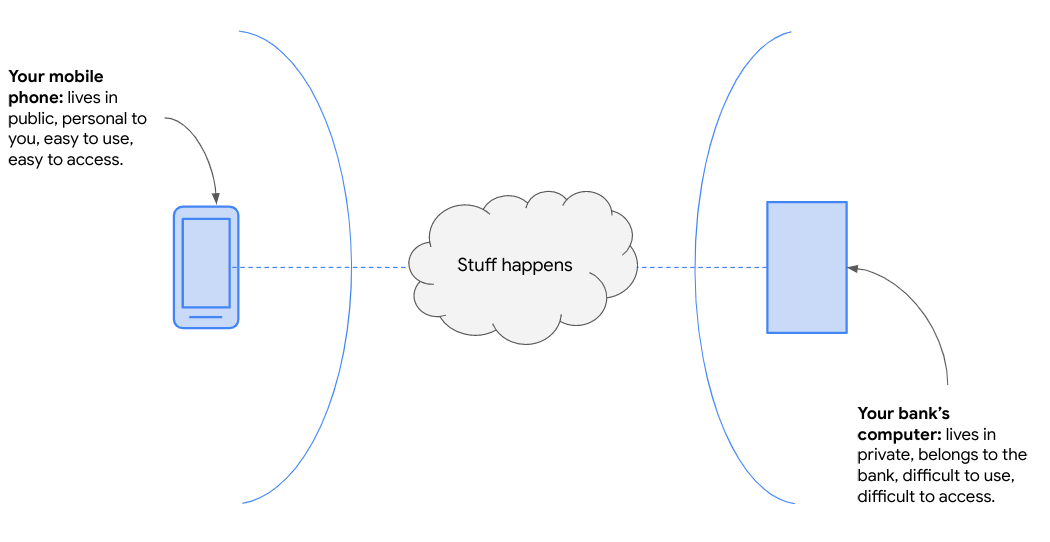
Let’s start with a problem. You think some bills have just been paid out of your account. You want to check how much money you have left. You have a computer in your hand - your mobile phone - but that computer does not currently know your balance. There is at least one computer that does know your balance, but it does not belong to you, and it sits in a large building hundreds of miles away. How does the number that represents your balance get from your bank’s computer to the mobile phone in your hand?
This is one of a series of articles which explores how we use computers to run the world by considering the round trip question: what happens when we press a button on a mobile banking app which tells it to do something with our money?
Simply by virtue of being computers, the phone in your hand and the machine in your bank have a lot of similarities. For now, though, I’d like to explore their differences, as those differences are what makes the round trip question interesting.
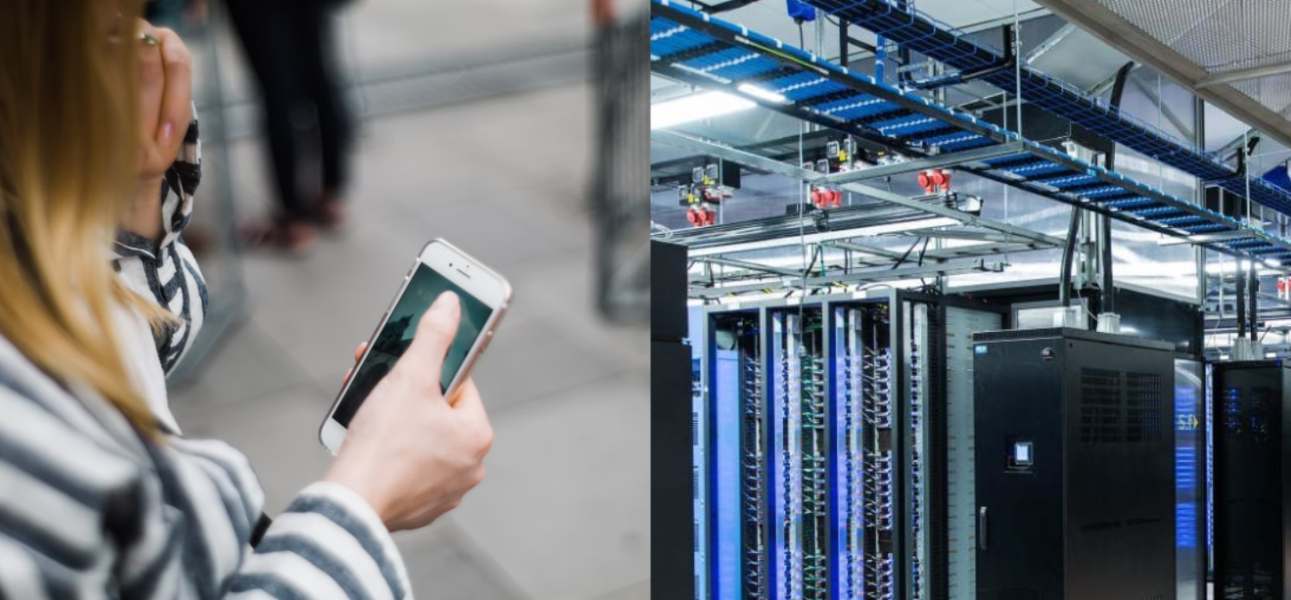
The bank’s computer lives a very private and sheltered life. It sits in a special building, in an environment with carefully controlled temperature and humidity. It also sits behind many physical barriers: walls, doors, gates and so on. Despite the frequency with which action heroes ‘break into the computer room to hack the mainframe’, getting to this computer without authorisation would be very hard. And even if you could reach the computer physically, there’s not much point: it doesn’t have a display or a keyboard. If you want to reach this computer, you do so over the network. And if you did reach this computer over the network, you would find that you needed deep specialist knowledge to do anything with it.
By contrast, your mobile phone lives its life in public. When you’re not using it, it sits in your pocket or your bag, but much of the time it’s in your hand, in the sun and the rain and the snow. You sometimes leave it lying on your desk or beside your bed. Lots of people could pick it up and access it, and there’s a lot they could do with it: this computer is almost all physical interface. You rely on the security that the manufacturer built in, whether that’s a password, fingerprint recognition or facial recognition. But if someone got past that security, they could do a lot with your mobile phone: it’s designed to be easy to use with no specialist knowledge.
To solve the problem of how we get your balance from the bank’s computer to your mobile phone, therefore, we need to figure out how to bridge these two worlds: the dark, private, secure world of the bank’s computer, and the bright, public, connected world of your mobile phone. And we need to do that in a way which lets nobody else see your balance or access your account.
To take the next step in figuring out how to bridge these worlds, we’ll need to consider a fundamental question: what makes a computer a computer? I’ll attempt to address that question in my next article.
The Round Trip Question: Journey Map
This series of articles is driven by a conviction that computing is increasingly important to our lives, but the understanding of computing is asymmetrical, and that people working in the industry therefore have a duty to address that asymmetry. There is, of course, a high risk that these articles will be boring for specialists and baffling to non-specialists, but I’m hoping to find interest and knowledge along the way, and to uncover my own areas of ignorance. I’ll use this section at the bottom to capture the list questions which arise as I write each article. If I go wrong, or if you have other questions, please tell me in the comments.
Questions to answer:
What makes a computer a computer?
How does my mobile phone know that I am me?
How does my bank’s computer know that I am me?
Why do action heroes ‘break into the computer room to hack the mainframe’? How realistic is that?
What’s a mainframe?
What’s a computer room?
There will be plenty more questions. For now, though, here’s the very rough picture of what we have covered so far: