- agents
- AI
- APIs
- architecture
- augmented reality
- books
- bureaucracy
- career
- change
- Christmas
- cloud
- collaboration
- communication
- complexity
- computer history
- corporate life
- data
- decisions
- delivery
- devops
- end user tools
- ethics
- failure
- fear
- fundamentals
- gaming
- government
- history
- humans
- hype
- identity
- infrastructure
- innovation
- language
- leadership
- learning
- legacy
- management
- measurement
- mental health
- money
- networking
- New Year
- operations
- partnership
- philosophy
- physics
- platforms
- prediction
- process
- procurement
- programming
- quantum
- reliability
- resilience
- risk
- robotics
- science
- science fiction
- security
- shadow IT
- space
- standards
- strategy
- teaching
- teams
- technical debt
- technology advocacy
- testing
- thinking
- transformation
- TV
- virtues
- vision
- writing

Thanks for the panic: can we turn that energy into something useful now?
There have been a lot of big things to worry about related to AI recently: mass loss of jobs, hacking attacks, rogue agents, stock market bubbles, existential threats to humanity, machines with souls, online torture chambers and so on. This worry has been amplified by the weird see-saw positions from AI companies, which go something like: ‘Everything’s going to be great! Unless it’s terrible. Unless it’s great! Unless it’s terrible.’
Panic may seem an appropriate response to such alarming prospects, contradiction and confusion, especially when it feels like there is little that you can do about them personally. Can you use Copilot to compose an email in a way that avoids intellectual decay and environmental catastrophe? Does adding ‘please’ at the end of your prompts (or avoiding doing so) express a position about whether models have rights and consciousness? When you write code that calls an LLM API, are you surrendering or protecting your organisation’s independence and sovereignty? Meaningful engagement feels out of our reach; panic, frustration and the sense of being overwhelmed are always at hand.
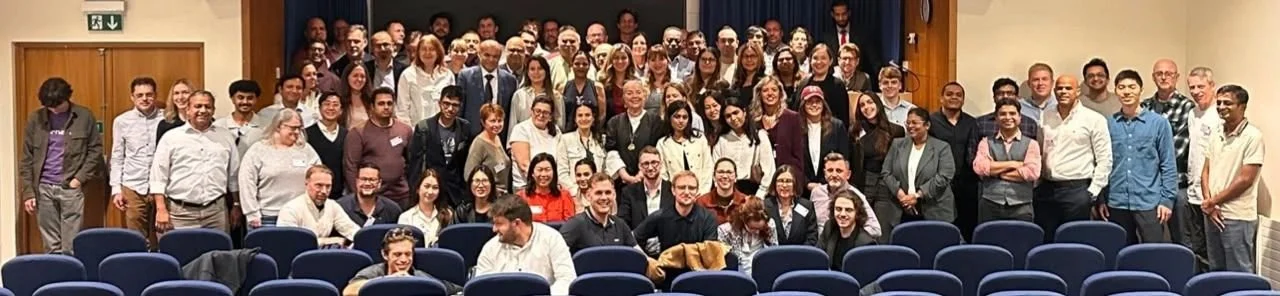
Curious humans help each other think better
I was privileged to attend and speak at the AI Summit in Oxford last week (with huge thanks to Ajit Jaokar and the rest of the team for making it happen). As ever, I learnt a lot from the formal presentations, and even more from the conversations during breaks. However, the moments that really shaped my thinking were those which challenged my preconceptions. Here are three of those challenges:
Why don’t you like the Stoics?
In my own keynote session, I talked about one of my favourite topics: AI ethics, and how we can use ideas about virtue, vice and flourishing to develop a rounded, flexible and human response to the challenges of new technology. (I also wrote about this last week.) In that talk, I dismissed other forms of philosophy that seem to be popular in Silicon Valley, particularly utilitarianism (too concerned with optimisation), deontology (too focused on finding rules which probably don’t exist) and Stoicism. I also rashly promised, that I would explain my antipathy to these schools of thought during the break.
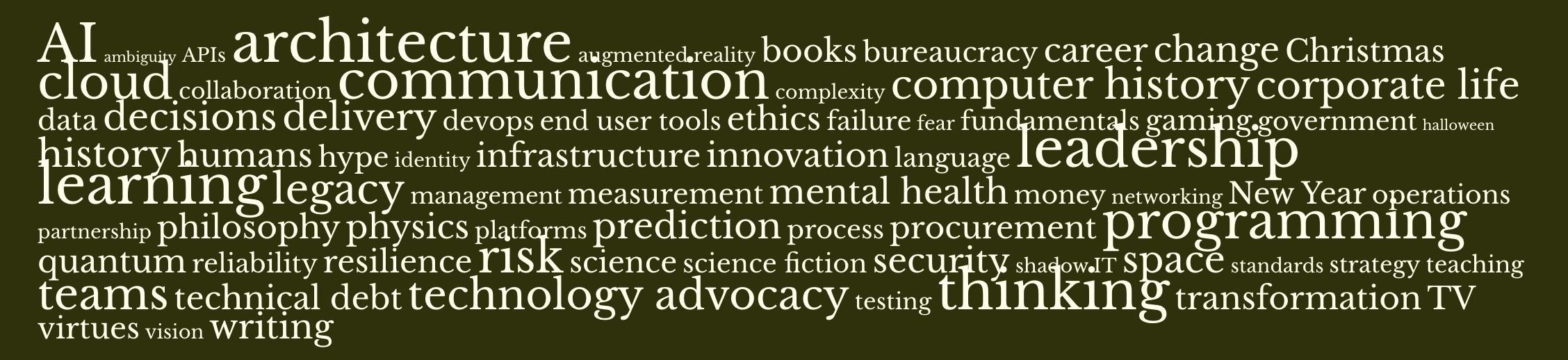
What was I thinking?
A few months ago, I decided to set up this blog site to hold all of the articles I have published on LinkedIn, whether in the A Lot to Learn newsletter or standalone articles from before LinkedIn used newsletters.
That might seem like a self-indulgent exercise, but I thought, first, that it might be useful, and, second, that, if it was useful, I might need a content lifeboat. Unfortunately, social media platforms tend to decay, and I anticipated that there might come a point in the future where I didn’t want to be on this platform any more. (I won’t comment in depth here about the quality of LinkedIn, other than to say that I have a mental threshold for the number of toxic, divisive posts I’m prepared to see, and, sadly, the content here increasingly approaches that threshold.)
Whatever the motivation, I found the process of transferring articles across to the new site interesting. I kept thinking that this is exactly the sort of busywork that I should be using AI to help with, but found that I enjoyed the process of reviewing what I had previously written and trying to figure out what I thought about it.

What is 54?
I didn’t set out to create a puzzle: I set out to create a way of recognising talented technical people.
When I was working for the UK Government, I saw that its Digital and Data profession suffered from the same problem as every other technical group working in a traditional organisation:
The organisation recruits talented technical people.
The talented technical people do good work.
People who do good work expect to advance their careers.
Career advancement means taking on management responsibility.
Talented technical people are not always talented managers.
EITHER talented technical people become mediocre managers
OR talented technical people seek career advancement elsewhere
OR (sometimes) they combine management and technical success.

Learning the fundamentals: beyond the IT slot machine
Business executives often experience their IT department as a slot machine: something that consumes money, occasionally gives a payout, and whose inner workings are opaque and inscrutable.
Sure, sometimes the slot machine gets new lights and buzzers which claim to give an idea of what it is going to do (project plans, progress reports and dashboards), and sometimes it gets new buttons which make players feel as if they are in control (steering committees, governance processes and change boards). But the machine still seems to keep on doing the same old random things, as if the lights, buzzers and buttons weren’t actually connected to anything.

The hand shapes the tool; the tool shapes the hand
Humans make tools: it is one of our defining characteristics. But our tools shape us, just as we shape our tools. If, like me, you don’t usually do a physically demanding job, try using a hammer for a few hours, and experience the blisters that it raises. Try using it for a few more days, and feel your calluses and other changes in your body.
Researchers now believe that our hands have been shaped by our history of tool use. Early human species (always remember that Homo sapiens is not the only, or the first, species of human) had weak wrists and clumsy digits compared to modern humans. The development of stone tools, and their impact on prospects of survival, meant that, from approximately 1.7 million years ago, the structure and strength of our hands evolved to get better at using tools. Our tools wrote themselves back into our DNA.

Look! I made a machine do a thing!
When I am doing hobbyist computer stuff, I often have moments which can be summarised as, Look! I made a machine do a thing! These moments bemuse family and friends, who are summoned to witness the thing that I have made the machine do, only to see a splurge of text at the command line, or an underwhelming web page. (But look at it - it works!)
The feeling of successfully making a machine do a thing is such an important phenomenon in computing that I think we should give it a name: perhaps LIMAMDAT, or LIMDAT for brevity and ease of pronunciation. The history of computing has been full of LIMDAT moments, from the first decrypts and trajectory calculations in the 1940s, through rocket launches and Moon landings, to the birth and development of the Internet.
Lessons from forty years of Excel: if you give people tools, expect them to be used
One of the anniversaries I missed last year was that of Microsoft Excel, which turned forty in August.
I think that anybody who has worked in enterprise technology over any part of those four decades will have mixed feelings about Excel. On one hand, they will be grateful for a flexible tool which almost everybody has access to, most people know how to use, and which can be used for modelling and forecasting without the need to run big projects or write complex programmes. On the other hand, they will remember the times when a major upgrade was delayed because of a set of fragile, convoluted macros, when a business critical operation depended on a spreadsheet which only one person understood, or when they were asked to ‘just’ take the logic embedded in a spreadsheet and make it into a system that worked for the whole company.

A few phrases to help resist AI illusions
‘It can’t hurt you: it’s not real!’
You might hear those words from the hero of a horror, science fiction or fantasy film. They could be walking through a dream world, subject to a hallucinogenic drug, or under the spell of a sorcerer. They know that the things that they are seeing are not real, and that all they have to do is to try to ignore what they think they can see and hear. Telling themselves that what they are experiencing is not real is a guard against fear, against stepping off the path, or, worst of all, the temptation to talk back to the illusions.
Dealing with current forms of AI can feel like this. Not just because AI is surrounded by hype, marketing, inflated expectations and a big dose of FOMO. And not just because AI can be used to produce fake videos, fake images and fake words.

A suggested New Year’s resolution: be more curious
When I was growing up, my Dad and my uncles were always working on cars and motorbikes. This was partly through need: they didn’t have much money and they had to travel for work, studies and family life, so fixing a car using spare parts, ingenuity and improvisation was an essential skill. They also enjoyed it: it was as much of a hobby as a necessity.
It was not a practice I ever acquired the skill or the appetite for. I was much more interested in reading books than getting my hands covered in grease and oil. I enjoyed spending time with my Dad and Uncles as they struggled to fit strange shaped pieces of metal into strange shaped spaces, and as they scoured scrap yards to find an old car with the right part. But I never really understood what they were doing.

Reflections on a vertical learning curve
Today is my last working day as CTO for the UK Government.
Three years ago, I had just learnt that I might be offered this job. I was completely uncertain about whether I should say yes or not. Fortunately, my wife, as ever, gave me good advice – to talk to some experts and mentors, who knew me and the kind of work I did, and to get their perspectives.
Those conversations yielded two insights. First (from people who were naturally analytical), when we plotted pros and cons, the pros sounded like reasons to do the job, and the cons sounded like work to be done – and therefore more reasons to do the job. Second (from people who thought in terms of purpose), I discovered a strong sense of public duty: for an example, an Australian friend told me that if his country asked him to do an equivalent job, he would accept with pride.

Please pay attention to the safety briefing
What do you do when the air crew ask you to put down your books or devices and pay attention to the safety briefing? Do you follow their advice, because this aircraft may be different to those you have flown on before? Do you study the safety card when the briefing is over? Do you check that you know the location of the life jacket, under your seat or in the compartment next to you? Or do you zone out, diving deeper into the mental limbo that air travel induces, waiting for the moment when you can start reading, scrolling or checking emails again?
I expect that most of us regard the safety briefing as a dull but worthy formality, and don’t pay as much attention as we should. However, I also think that perhaps we should regard it differently, and learn some lessons about how we achieve safety in enterprise technology.