- agents
- AI
- APIs
- architecture
- augmented reality
- books
- bureaucracy
- career
- change
- Christmas
- cloud
- collaboration
- communication
- complexity
- computer history
- corporate life
- data
- decisions
- delivery
- devops
- end user tools
- ethics
- failure
- fear
- fundamentals
- gaming
- government
- history
- humans
- hype
- identity
- infrastructure
- innovation
- language
- leadership
- learning
- legacy
- management
- measurement
- mental health
- money
- networking
- New Year
- operations
- partnership
- philosophy
- physics
- platforms
- prediction
- process
- procurement
- programming
- quantum
- reliability
- resilience
- risk
- robotics
- science
- science fiction
- security
- shadow IT
- space
- standards
- strategy
- teaching
- teams
- technical debt
- technology advocacy
- testing
- thinking
- transformation
- TV
- virtues
- vision
- writing

Features are like feathers: you never know how they will be used
We now know that many dinosaurs had feathers. However, this doesn’t mean that all feathered dinosaurs could fly: it is believed that feathers first evolved for insulation rather than flight, and developed over millions more years to provide lift as well as warmth.
Feathers are an example of exaptation: a term proposed by Stephen Jay Gould and Eilsabeth Vrba in 1982, to describe the phenomenon of something that evolved for one purpose, and has been adapted by evolution to serve another purpose. Other examples include the development of two of the bones that formed part of the reptilian jaw to become the malleus and incus, essential parts of the mammalian ear: we hear with bones that reptiles use to eat.
Exaptation is a useful concept in technology too, and we do not have to wait millions of years to see it in action: human ingenuity acts faster than evolution. For example, take the powerful computing devices we carry in our pockets and call ‘mobile phones’.

Breaking the cloud barrier
On October 14th, 1947, Chuck Yeager became the first human to break the sound barrier, flying the Bell X-1 experimental plane. Prior to that event, there had been serious doubt about whether it was possible to break the sound barrier at all: aircraft approaching the barrier had experienced buffeting, instability and even crashes. However, Yeager’s flight was remarkably smooth: his plane had been designed for supersonic flight. Yeager later said, ‘I realized that the mission had to end in a let-down because the real barrier wasn’t in the sky but in our knowledge and experience of supersonic flight.’ Your and my definition of a let-down may vary from Yeager’s definition.
I believe that the experience of human efforts to break the sound barrier is analogous to enterprise efforts to adopt new technology. Right now, this is particularly apparent in the adoption of public cloud. Despite being convinced of the advantages of software defined, elastic, on-demand platforms, every organisation seems to have its own version of the sound barrier when it comes to cloud. Let’s call it the cloud barrier.

Enterprise technology and the mysteries of the universe
In 1933 our understanding of the universe changed. Fritz Zwicky, a Swiss Astronomer working in California, observed that the Coma cluster of galaxies was rotating so fast that there was simply not enough mass to hold it together. The cluster shouldn’t exist. He termed the phrase ‘dunkle Materie’, or ‘dark matter’, to give a label to the missing mass that must be holding it together through the force of gravity.
It took decades for the concept of dark matter to be accepted more widely, but it is now a part of our standard description of the universe. We still don’t know what dark matter is, but believe that it outweighs normal matter by a factor of more than five to one.
That’s an astonishing thought. Everything that we can see - the Earth, the Sun, the stars, ourselves - makes up only a fraction of the matter that exists in the Universe.

Perspective for technology architects: keep thinking bigger
In 1959 the physicist Hugh Everett met with Niels Bohr, one of the pioneers of quantum physics. He wanted to share an idea: that the strange behaviour of quantum particles could be explained by postulating that, every time a particle could be in multiple different states, it existed in all those states, but in different universes. This was an early version of what came to be called the many-worlds theory.
Unfortunately for Everett, the meeting did not go well. That wasn’t a surprise: Everett was trying to convince one of the creators of the Copenhagen interpretation of quantum physics that that interpretation was wrong - and he had even gone to Copenhagen to do it. Everett admitted that the meeting was ‘doomed from the start,’ and he turned out to be right. He could not even establish sufficient common ground to have a meaningful discussion.
Although the idea languished for many year, seventy years later, the many-worlds interpretation is treated as a serious, if controversial, way to describe the universe.
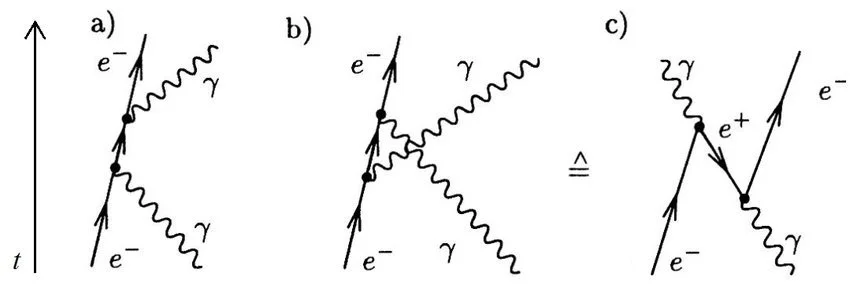
Which of your ideas will survive the cataclysm (or at least the end of the meeting)?
At the beginning of his famous Lectures on Physics, Richard Feynman said something that is so important and so useful, it is worth quoting at length:
“If, in some cataclysm, all of scientific knowledge were to be destroyed, and only one sentence passed on to the next generation of creatures, what statement would contain the most information in the fewest words? I believe it is the atomic hypothesis (or the atomic fact or whatever you wish to call it) that all things are made of atoms – little particles that move around in perpetual motion, attracting each other when they are a little distance apart, but repelling on being squeezed into one another. In that one sentence, you will see, there is an enormous amount of information about the world, if just a little imagination and thinking are applied.”
This passage not only conveys an essential piece of scientific knowledge, but focuses with precision on what Feynman considers to be the most essential piece of scientific knowledge, and expresses it using very ordinary language. I believe that there is an important lesson here for technology architects.

Turn conflict into work with TATWAO and TITWTBD
In the mid-19th century James Prescott Joule proposed the theory that different types of energy could be converted to one another: specifically, that heat could be converted to work, defined in terms of mechanical motion. This idea was not well received at first: the dominant theory was that heat was a type of fluid (caloric), which could not be created, destroyed or converted. However, Joule was persistent (and right): his theory prevailed, and the SI unit of work, the joule, is named after him.
Technology architects should recognise Joule’s theory. A big part of our job is to convert metaphorical heat, in the form of conflict, confusion and disagreement, into work.
One of the challenges Joule needed to overcome to prove his theory was to create tools precise enough to measure small changes in temperature and motion. Just like Joule, technology architects need their own tools and methods. Without them we, like most other people, often struggle to cope with conflict. Even though we may encounter it every day, we don’t always enjoy the experience of people disagreeing loudly and energetically, and find it hard to get those people to move from emotional to rational discourse.