- agents
- AI
- ambiguity
- architecture
- augmented reality
- books
- bureaucracy
- career
- change
- Christmas
- cloud
- collaboration
- communication
- compliance
- corporate life
- data
- decisions
- delivery
- devops
- disagreement
- end user tools
- ethics
- failure
- fear
- fundamentals
- government
- halloween
- history
- humans
- hype
- identity
- inclusion
- infrastructure
- innovation
- language
- leadership
- learning
- legacy
- management
- measurement
- mental health
- money
- networking
- New Year
- operations
- philosophy
- physics
- platforms
- prediction
- privacy
- process
- procurement
- products
- programming
- quantum
- reliability
- resilience
- risk
- science fiction
- security
- shadow IT
- space
- strategy
- talent
- teaching
- teams
- technical debt
- technology advocacy
- testing
- thinking
- transformation
- TV
- virtues
- vision
- writing

Built in or bolted on?
If you are a technology architect, do you regret the complexity of your legacy architecture? Do you wonder how you ended up with so many layers, and so many different technologies which do similar jobs - but never quite seem to do 100% of any particular job?
I believe that feeling dissatisfied is a natural part of the life of a technology architect. However, I also believe that we should extend ourselves a little forgiveness. It is true that some of the complexity in legacy estates is our fault: sometimes we have not been successful in convincing people to address technical debt, and sometimes we have failed to resolve disputes between champions of different technologies. But much of the complexity in legacy estates is simply a function of time and the continuously changing environment in which enterprise technology must operate.

Accelerate off the plateau
What’s your memory like? Mine is far from perfect, especially for names and faces: let me take the opportunity to apologise in advance to anybody I haven’t seen during the long lockdown, and who I fail to recognise when we meet again. If you see me with a polite smile and a confused look, I am probably trying to jolt my memory into action.
In his book Moonwalking with Einstein, Joshua Foer attempted to answer the question of how to improve his memory, and ended up competing in the U.S. Memory Championships. To do this he had to train hard to master various events, such as memorising random lists of binary digits, long poems word for word, and the order of multiple packs of playing cards. I found many interesting ideas in Foer’s book about the history of memory, the techniques used to improve memory, and about talent and expertise. There is one particular idea, though, that made me think about how we develop throughout our careers, and the conditions that leaders must create to support that development.

Is my red your red? Is my experience your experience?
There’s a longstanding (and possibly unanswerable) question of whether one person’s experience of the physical world is the same as another person’s experience of the physical world. The question is often framed in terms of colour: (if we have no visual impairments) I know what it is like to see the colour red; you know what it is like to see the colour red; we even agree on the things that are coloured red; but we cannot know whether our subjective experience of red is identical.
Whether it is possible to answer this question or not, I think that there are things that have the same external, physical characteristics, but very different subjective experiences: our interactions with other people. I also think that this difference is amplified by working from home in lockdown. (And, as ever, I have to point out that when considering this experience, those of us working from home have to remember how fortunate we are to be healthy, housed and in work.)

From the data lake to the front page of data
How many times have you tried to build a data lake? Or, to put it another way, how many times have you tried to solve the analytics problem? I have to confess that I have tried more than once - and had varying success, until I learnt to think about the problem differently.
The problem is familiar: our enterprise has data which we believe to have value; that data is sitting in systems of record which are hard to access; those systems sit on infrastructure which is optimised for transactions rather than analytics.
We also have solutions which are familiar, even if they have taken different forms over the years: we pull the data out of our systems of record; we organise it into a form which is easier to analyse; and we place it on infrastructure which is optimised for analytics.

Psychological safety in teams: what can you achieve when you stand on solid ground?
This week, it snowed in the town where I live. I know that all my friends and colleagues in much colder parts of the world will tell me that it didn’t really snow: we just had a couple of inches. But even that small scattering changed the way the world looked, changed the way I interact with the world, and also prompted some thoughts about psychological safety, confidence and my own response to challenges in the workplace.
For the first couple of days, the world was transformed. The streets had that special quality they have after the first snowfall, when everything seems soft, quiet and pristine. I couldn’t wait to get out and walk in the snow (to the extent allowed by current lockdown restrictions). It was cold, but the snow was powdery and I felt completely safe to explore the changed environment.

For digital transformation, learn to care about code (and people)
For my 12th birthday my parents bought me an Acorn Atom microcomputer (yes, I am that old). This meant that I learnt to code at a young age, and acquired a love for computing which has stayed with me throughout my career.
As the world changes, and more and more companies attempt digital transformation, I am ever more grateful to my parents for the gift of my first computer, not just because it led me to a rewarding career, but because it gave me an understanding of the technology that runs more and more of the world. Modern computers are many times more powerful than that first little machine, and I doubt that anybody codes in Atom BASIC any more. Coding projects start with frameworks and libraries rather than a program printed in a magazine, and CI/CD pipelines involve rather more than typing RUN. And yet, code is still code.

Three lessons from Ganesh: purpose, focus and community
My friend and colleague, Balasubramanian Ganesh, retired from HSBC this month to pursue the next stage of his career: setting up and running an NGO in India. Anyone who knows Ganesh knows that he will make this endeavour successful, and that he will make a difference to many lives. I’ve had the privilege of working with and for Ganesh in three different companies over more than a dozen years, and would like to share three lessons I have learnt from him.

To lead others, it helps to understand yourself
The best questions are those which make you think. I had the chance to talk to a group of emerging leaders this week, and was intrigued to be asked the question of whether self-awareness was something I had consciously worked on in my own development as a leader.
The time it took me to come up with an answer might be taken as a signal that I’m not particularly self-aware. However, the truth is that self-awareness is something that I have consciously worked on throughout my career. I can say with confidence that in the very earliest stages of my career, as a young software developer, I was self-conscious (in the sense that I was painfully shy and uncomfortable in my own skin) but not particularly self-aware (in the sense that I had limited understanding of my own areas of strength and weakness, of what motivated me and what didn’t, and of what effect I had on others).

Risk Management: the often overlooked dimension of Digital Transformation
I have to confess that I’m not good at keeping New Year’s resolutions: I find it hard to change my behaviour on the basis of a single decision that happens to coincide with the end of the year. The ubiquity of broken New Year’s resolutions also seems to give me permission to break my own. But this year will be different! I’m going to try something that I hope will not be too hard and will be of some interest: to share some thoughts about Digital Transformation which have been bouncing around my head for a while - and through sharing them, give them form.
As these thoughts form, I expect they will almost fall into the classic people, process and technology triad. The one difference is that, when we talk about Digital Transformation, I think that we should talk about practices rather than processes. This might seem like a fine semantic point but, to me, a process is something that people follow (the process is in charge), whereas a practice is something that people do (the people are in charge). Practices seem to fit a world of autonomy, skill and expertise - people doing the work that cannot be done by machines.

If you’re going to land on the Moon, at some point you have to land on the Moon
The recording of the Apollo 11 Moon mission, just before the Eagle lands in the Sea of Tranquility, never fails to make my hair stand up. The tone of the astronauts is matter of fact, calm and professional: if you didn’t know the context then you would never imagine that they were engaged in one of humanity’s greatest endeavours.
And the more of the context you know, the more astonishing that air of calm becomes. Those last minutes before the landing were filled with alarms, unexpected behaviour from the lunar module, an overshoot of the planned landing site, and a search for a favourable place to land. By the time the module touched down, the craft had less than 5% of its fuel left, and was less than thirty seconds away from abandoning the mission. (This page gives a full transcript of the last 13 minutes before landing, and a great commentary on what was going on behind the words.)
Celebrating our celebrations
If you celebrate Christmas, when did you put up your decorations this year?
In our house, we don’t normally put our decorations up for very long: about a week or so each side of Christmas. But this is not a normal year: we put our decorations up a week early, and I think that many other people did the same. This year (if you live in the Northern Hemisphere) it felt like we needed those extra lights in the darkest time of the year. Even though the timing might have been a break with tradition, it felt important that we could still keep some traditions in some form, despite the challenges we face together.
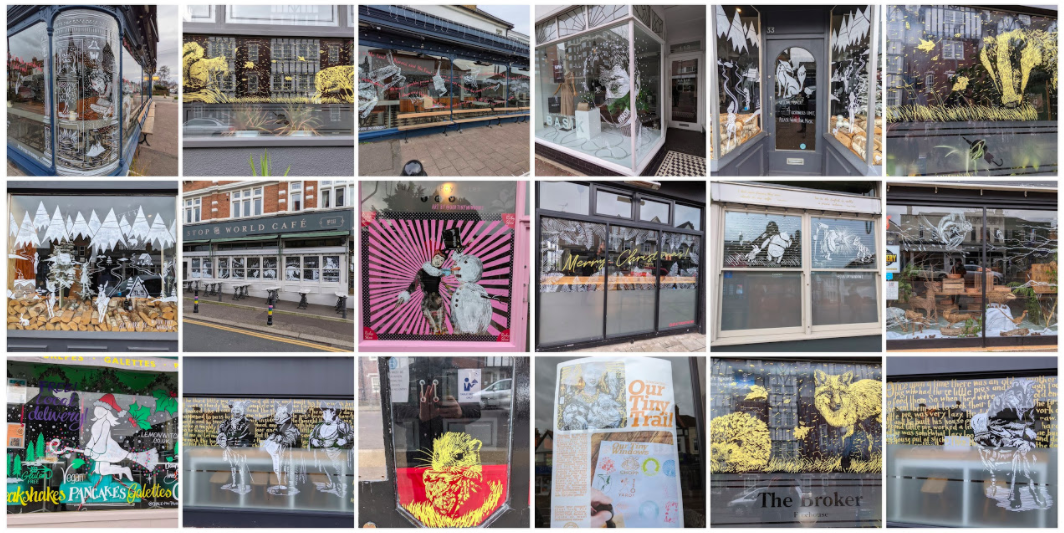
The value of decoration was brought home to me even more this year by the extra effort made by the shops in the town where I live. For the past few years, many of these shops have had their windows painted by a handful of local companies, but this year even more seemed to join in. The picture at the top of this article shows just some of these paintings.

Relearning the habit of focus
Just last week, I wrote that the upcoming Christmas holiday in the UK, with many remaining restrictions on what we could do and where we could go, was an opportunity to reinforce or acquire habits of work/life balance, after many months of working from home.
What I didn’t expect was that, with new variants of the virus circulating, restrictions would become even greater.. The Christmas holiday, which already often contains long stretches of unstructured time - particularly that fuzzy period between Christmas Day and New Year - would be even more unscheduled and unstructured, as even our limited plans would have to be cancelled.
Is there any silver lining to be found in the next phase of our evolving situation? If there is, I think it is in the opportunity to relearn the habit of focus: to spend dedicated time on one thing, to the extent that we lose ourselves in it.