Enterprise technology and the mysteries of the universe
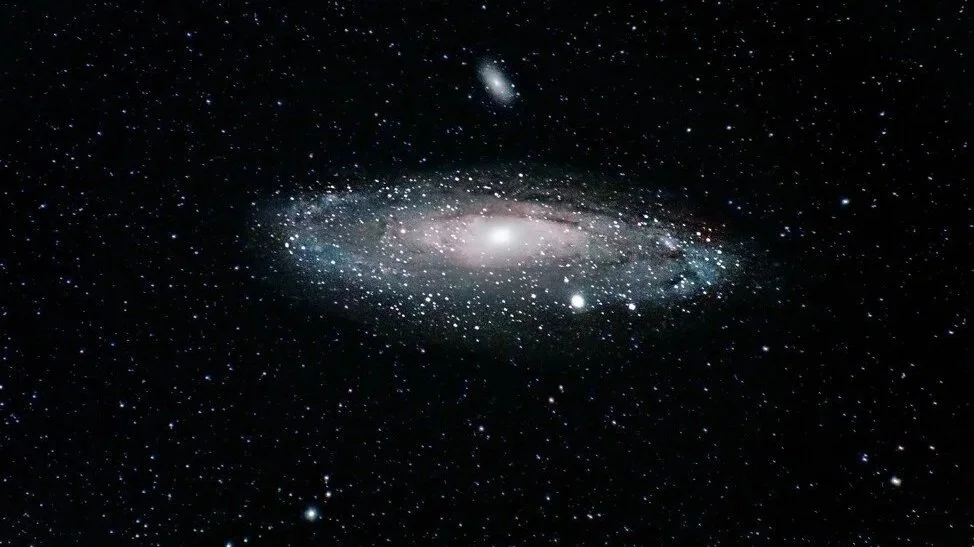
Photo credit: Dario Bronnimann on Unsplash
In 1933 our understanding of the universe changed. Fritz Zwicky, a Swiss Astronomer working in California, observed that the Coma cluster of galaxies was rotating so fast that there was simply not enough mass to hold it together. The cluster shouldn’t exist. He termed the phrase ‘dunkle Materie’, or ‘dark matter’, to give a label to the missing mass that must be holding it together through the force of gravity.
It took decades for the concept of dark matter to be accepted more widely, but it is now a part of our standard description of the universe. We still don’t know what dark matter is, but believe that it outweighs normal matter by a factor of more than five to one.
That’s an astonishing thought. Everything that we can see - the Earth, the Sun, the stars, ourselves - makes up only a fraction of the matter that exists in the Universe.
But the story is far from finished. In the 1990s, different teams of scientists attempted to measure the rate of expansion of the universe. Just as Zwicky was surprised to discover that the Coma cluster was rotating faster than it should be, they were surprised to discover that the universe was expanding faster than expected. Even more surprising, the rate of expansion was increasing. At a loss to explain how this could be the case, they coined the term ‘dark energy’ to describe whatever force is accelerating universal expansion.
And, if we figure out the mass that would be equivalent to this dark energy, we find that it makes up 67% of the universe. Visible matter is even less important than we thought, making up only 5% of the universe.
Most of the universe is a mystery to us, knowable only by its effects.
These are cool and disconcerting facts, but what do they have to do with the technology topics that I normally write about? Enterprise technology is not as fundamental to the universe as dark energy and dark matter. However, I think that there is a parallel which may help us to think about it in a useful way.
I believe that many people within large enterprises are in a similar state to the rest of us before we heard about dark matter and dark energy. They observe the visible manifestations of their organizations: people, buildings, equipment, factories, branches and so on. They believe that this is what their organization is made from.
And yet, they feel the force of a mysterious weight. For some reason, everything is harder to move than it should be. It has unexpected levels of inertia. At the same time, they feel the force of a mysterious expansion. For some reason, costs and headcount keep growing.
In this analogy, dark matter represents the software that runs a company, while dark energy represents everything that is required to make this software work: infrastructure, data and, of course, people. The effort required to change software is like the mass of dark matter, and the continued outward pressure on the technology budget corresponds to dark energy.
While this is just an analogy, I think it is useful in three ways.
First, dark matter and dark energy don’t just supplement normal matter: they make up the majority of the universe. In a similar way, technology makes up the bulk of many companies to the extent, if their technology suddenly disappeared, they would not simply struggle: they would cease to exist. The pernicious business / technology distinction that has persisted for years failed to acknowledge that, in many senses, the technology is the the business.
Second, dark matter and dark energy are two distinct phenomena (at least as they manifest to us today - they may turn out to be aspects of a more fundamental phenomenon once we know more). Similarly, while it is tempting to focus on the purely technical aspects of technology (the software that we build and run), this only gives us a small slice of the picture: systems are made up of software, people, infrastructure and data, and the non-software parts of the system are often the greatest determinants of its behavior.
Third, dark matter and dark energy are deeply mysterious (at least for now). While we have hypotheses about what they might be, none have been proven. It is daunting and disconcerting that there is so much of the universe that is unapproachable. It seems that many people who have not had the chance to work with technology feel the same way. Technology is not just a mystery: it seems a mystery that they have no way to get a grip on.
The good new is that, after all, this is only an analogy. Technology is not as mysterious as dark matter and dark energy - as long as technologists are willing to take the time to explain, and non-technologists are willing to take the time to learn. Maybe analogies like the one in this article will help. If humans can be curious enough to probe the deepest secrets of the universe, surely we can be curious enough to probe the secrets of our data centers.
