The hand shapes the tool; the tool shapes the hand
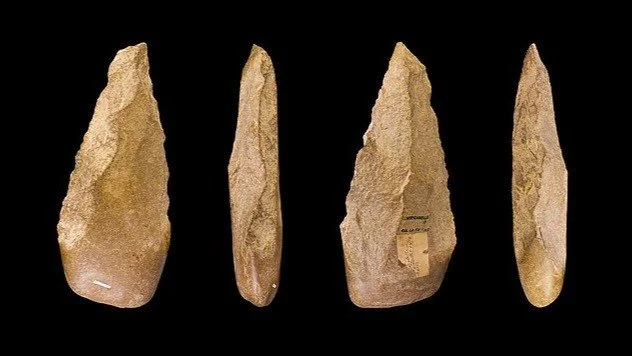
Photo credit: Didier Descouens via Wikimedia Commons, under Creative Commons Share Alike 4.0
Humans make tools: it is one of our defining characteristics. But our tools shape us, just as we shape our tools. If, like me, you don’t usually do a physically demanding job, try using a hammer for a few hours, and experience the blisters that it raises. Try using it for a few more days, and feel your calluses and other changes in your body.
Researchers now believe that our hands have been shaped by our history of tool use. Early human species (always remember that Homo sapiens is not the only, or the first, species of human) had weak wrists and clumsy digits compared to modern humans. The development of stone tools, and their impact on prospects of survival, meant that, from approximately 1.7 million years ago, the structure and strength of our hands evolved to get better at using tools. Our tools wrote themselves back into our DNA.
And, of course, our use of tools has shaped our environment as well as our biology. The layout of our cities, the distribution of population, the shape of our houses, are all determined by the tools that we use for transportation. I am writing this article from the 16th floor of a tower block, in a room that I could not reach if not for elevators, and which would be uninhabitable if not for air conditioning in the Summer and heating in the Winter.
I have spent my career attempting to understand and use a particular set of tools, those associated with digital computing and data processing. I have those tools serve and shape the companies to which they are deployed: to influence the size of the workforce, the relationship with customers, and the nature of products. I have seen the world change from one in which work starts with arrival at the office, to one in which work starts when you switch your machine on, to one in which work continuously arrives on a machine which you always have with you. I know that these shifts, and a lifetime of exposure to this technology, have shaped my own thought and behaviour.
The point of these reflections is, of course, that we have recently acquired a new set of tools, in the form of generative AI. And many of us are picking up these tools every day: we are using them to help us develop code, to write content (not this article!), or to summarise information. Some people are using them for advice and companionship, while others are struggling to imagine how that works. Even if we do not consciously choose to use these tools, they are appearing in our lives anyway, in our search results, in our office tools, in the films we watch and the books we read.
And there is no doubt that these tools are already shaping us. To take a trivial example, most of the time I find AI generated search results irritating and intrusive, and would prefer to see original sources. But if I want a quick summary of a complex topic, I increasingly find myself scanning the auto generated content. This shapes the Internet, by starving the downstream sites of traffic, but also shapes my thinking, as my mental model for the topic now depends on that summary.
It is too early to determine the long term effect of this shaping, and it is simplistic to assert that it is necessarily good or necessarily bad. We can probably agree that the existence of modern humans, with dextrous hands and minds, shaped by our early history of tool use, is a good thing. We can probably also agree that, if we had known exactly how we and our environments would be shaped by the car, we would have made some different choices - not to eliminate the car, but to shape it differently and to shape ourselves differently.
I believe that we should approach this moment, the moment when a new category of tool has appeared in our lives, with thought and reflection. We should note the habits and practices it creates in us and ask ourselves whether this is what we want, or whether we should take the trouble to direct it differently.
We shape tools and tools shape us. When we are conscious and thoughtful, we have an opportunity - quite possibly a narrow one - to decide how we want to be shaped.
