- AI
- ambiguity
- APIs
- architecture
- augmented reality
- books
- bureaucracy
- career
- change
- Christmas
- cloud
- collaboration
- communication
- complexity
- computer history
- corporate life
- data
- decisions
- delivery
- devops
- end user tools
- ethics
- failure
- fear
- fundamentals
- gaming
- government
- halloween
- history
- humans
- hype
- identity
- infrastructure
- innovation
- language
- leadership
- learning
- legacy
- management
- measurement
- mental health
- money
- networking
- New Year
- operations
- partnership
- philosophy
- physics
- platforms
- prediction
- process
- procurement
- programming
- quantum
- reliability
- resilience
- risk
- science
- science fiction
- security
- shadow IT
- space
- standards
- strategy
- teaching
- teams
- technical debt
- technology advocacy
- testing
- thinking
- transformation
- TV
- virtues
- vision
- writing

If you’re going to land on the Moon, at some point you have to land on the Moon
The recording of the Apollo 11 Moon mission, just before the Eagle lands in the Sea of Tranquility, never fails to make my hair stand up. The tone of the astronauts is matter of fact, calm and professional: if you didn’t know the context then you would never imagine that they were engaged in one of humanity’s greatest endeavours.
And the more of the context you know, the more astonishing that air of calm becomes. Those last minutes before the landing were filled with alarms, unexpected behaviour from the lunar module, an overshoot of the planned landing site, and a search for a favourable place to land. By the time the module touched down, the craft had less than 5% of its fuel left, and was less than thirty seconds away from abandoning the mission. (This page gives a full transcript of the last 13 minutes before landing, and a great commentary on what was going on behind the words.)
Celebrating our celebrations
If you celebrate Christmas, when did you put up your decorations this year?
In our house, we don’t normally put our decorations up for very long: about a week or so each side of Christmas. But this is not a normal year: we put our decorations up a week early, and I think that many other people did the same. This year (if you live in the Northern Hemisphere) it felt like we needed those extra lights in the darkest time of the year. Even though the timing might have been a break with tradition, it felt important that we could still keep some traditions in some form, despite the challenges we face together.
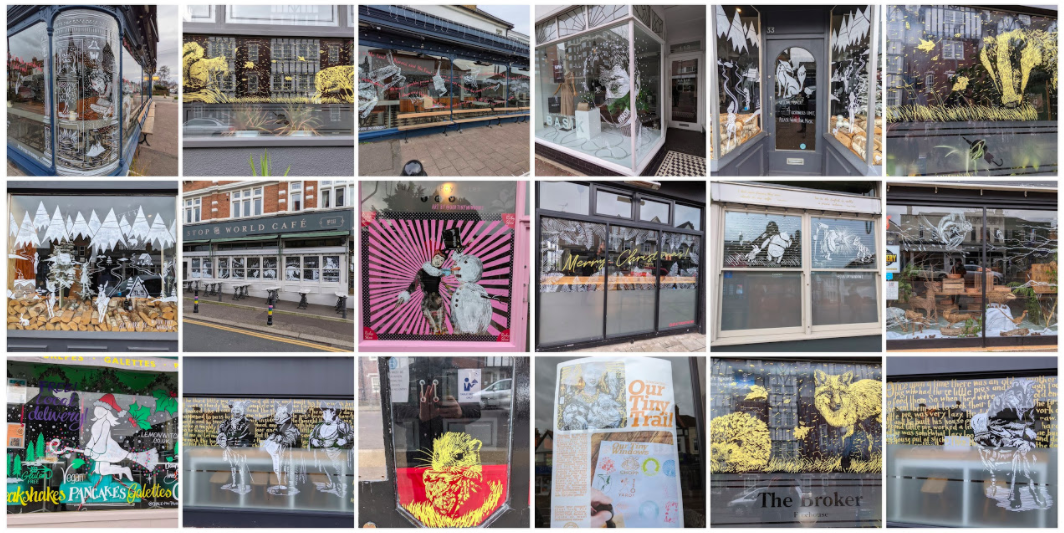
The value of decoration was brought home to me even more this year by the extra effort made by the shops in the town where I live. For the past few years, many of these shops have had their windows painted by a handful of local companies, but this year even more seemed to join in. The picture at the top of this article shows just some of these paintings.
Relearning the habit of focus
Just last week, I wrote that the upcoming Christmas holiday in the UK, with many remaining restrictions on what we could do and where we could go, was an opportunity to reinforce or acquire habits of work/life balance, after many months of working from home.
What I didn’t expect was that, with new variants of the virus circulating, restrictions would become even greater.. The Christmas holiday, which already often contains long stretches of unstructured time - particularly that fuzzy period between Christmas Day and New Year - would be even more unscheduled and unstructured, as even our limited plans would have to be cancelled.
Is there any silver lining to be found in the next phase of our evolving situation? If there is, I think it is in the opportunity to relearn the habit of focus: to spend dedicated time on one thing, to the extent that we lose ourselves in it.

Maintaining work/life balance in an unusual holiday season
For many people, the next day or so will be their last working day of 2020 before taking a break over Christmas and the end of the year.
Like so much in 2020, though, that break will not be like other years. Where I live, in the UK, there are still restrictions on travel, hospitality and social interaction, and while some of these rules will be relaxed briefly over Christmas, we will still need to exercise caution.
How should we spend our holiday time, then, when we can’t do much of what we would normally do?

Let’s (not) do the time warp again
How long has 2020 been for you? How long was the last week? Or the last month? Or the last hour?
If your experience has been anything like mine, none of our experience of time has felt anything like normal this year. Hours have dragged until days felt like weeks - while weeks and months have flown by like minutes and seconds. It simultaneously feels impossible that it is already December, and impossible that March 2020 was only nine months ago.
A recently published research paper based on the UK showed that 80% of survey respondents reporting experiencing distorted time during lockdown, and found that experience of distortion correlated with factors such as stress, insecurity and continuity and complexity of work. I am sure that further research into this phenomenon will follow, and that one of the small silver linings of this tragic year will be an improved understanding of this dimension of human experience and perception.

Thinking differently about . . . data
One of the first tools I used in my programming career was something that we would barely recognise as a tool today: it wasn’t a testing tool, or a deployment tool, or even a compiler. It was a physical rubber stamp used to create a variant of something called a Bachman diagram: a representation of an ICL IDMSX database structure. You used the stamp to create boxes that represented record types, and then filled in name and other characteristics in ink.
I share this story not just out of nostalgia (although I am sure that this will bring back memories for many people), but to illustrate just how differently we must think about data today than thirty years ago - and to remind us that, for many of us in senior technology leadership positions, we acquired skills, beliefs and habits in a world very different to that of today.

Thankful for new perspective
One of the many privileges I have had in my career is to work with people from all over the world, to learn about and take part in their traditions. This week, now that I am part of a team which is mostly based in the USA, I got to celebrate Thanksgiving in a small way: at our regular team meeting, we took the time to share the things that we were thankful for.
Naturally, everyone in the team was thankful that they and their families were healthy, and that, despite these strange times, they were employed and got to do interesting work in a great company. The thought that inspired me most, though, came from a colleague who said that she was thankful for the opportunity to choose who we are going to be as we come out of this crisis.

Finding wisdom in unexpected places
In strange and uncertain times, it helps to find wisdom, whatever the source.
I don’t mind admitting that, even though I am privileged to be healthy, housed and in work, I find it challenging to work in a world where we can’t meet each other in person, where I sit in the same room every day, and those days blur into a seamless stream.
In theory, as I no longer have to take the time to travel home on a train (or even a plane), I should end each day with the extra energy to put that lockdown time to productive use. In practice, I find that, most evenings, I don’t have the energy to do much more than watch TV. I suspect that I am not alone.

Use cloud to create focus
I feel slightly guilty as I write this article - but only slightly. I’m typing this on an old Macbook Air, and every now and then it reminds me that I haven’t backed up the hard drive for nearly a year. Whenever it does that, I feel a twinge of guilt - and then I dismiss the reminder.
The reason that I only feel slightly guilty is that it’s been a long time since that reminder mattered. I started making the shift from local storage to Cloud storage a few years back, and started making the shift from locally installed applications to Cloud based applications a year or so ago. While I’m typing this on a Macbook Air, I’m using Google Docs on a Chrome browser - and could be doing that on a range of devices.

To transform in isolation, create context
Imagine the experience of going to a meeting in a physical office, back when that was a normal thing to do (who knew a year ago that we would be nostalgic for featureless meeting rooms, grubby white boards, and markers that don’t work?). Don’t think about the content of the meeting: think about the context.
On your way to the meeting room, you walk past your colleagues and you catch glimpses of what they were working. You say hello to your friend who sits on this floor, but who you don’t see every day. You walk past the charts on the wall which show team performance and progress against the big project plan. You smile when you saw that the idea you sketched out on the whiteboard still hasn’t been wiped away.

Teaching is the killer app
When listening recently to the great BBC Radio 4 science show, The Infinite Money Cage, I learnt that, while chimpanzees and baboons learn from other members of their species (for example, tool using behaviour such as fishing for termites with twigs), there is much less evidence of active teaching.
We could congratulate ourselves on finding a way in which humans appear to be more advanced than our primate cousins. Teaching allows us to transmit knowledge, skills and wisdom across time and distance. It helps us to adapt to new environments and new circumstances. And its power and importance have only been reinforced by the current global pandemic.

Thinking differently about . . . DevOps
Last week, I claimed that technology leaders attempting to change the culture of their organisations should start with themselves. I think that this is especially true for technology leaders who are trying to introduce DevOps to their organisations. I am one of the people who have tried to do just that, and have not always been successful: as usual, this article is inspired by the opportunities I have had to make mistakes.
The concept of DevOps has been around for over ten years now, and has been described by more expert people than me, so I won’t attempt to give a precise definition here. (And I will also take this opportunity to say that, although I work for Google, a company which exemplifies many of the practices attributed to DevOps, the views in this article are my own.) I will, though, offer two ways in which I think about DevOps.