Completing the round trip: from centuries to microseconds
What happens when you press ‘send’ on your mobile banking app? I first posed what I called ‘the round trip question’ a few weeks ago, to illustrate that the people who build technology have a duty to explain. Over those weeks, I’ve explored the nature of computing, of digital communication, of identity, and of the humans who build and use systems. I’ll now attempt to give an end-to-end answer to the question, starting a little bit before you press that button . . .
Mid-19th century: Ada Lovelace and Charles Babbage collaborate on the Analytical Engine, intended to be the first programmable, general purpose computer, although it was never finished. Samuel Morse (and others) create a binary code for communication over telegraph wires.
1930s and 1940s: Alan Turing publishes the paper, ‘On Computable Numbers, With an Application to the Entscheidungsproblem,’ laying the theoretical foundations for digital computers. The theory is put into practice by the creation of Colossuss by Tommy Flowers in Bletchley Park.
1940s to yesterday: computing becomes an essential part of business and of life. Millions of people around the world design and build machines, lay cables, invent the Internet, write billions of lines of code, and figure out how to make it all work together. At some point, you buy a mobile phone, install your banking app and log on.
Now: You hit ‘send’. The software in your phone checks whether you are allowed to perform the task. If it’s an important task, like making a payment, it asks you to prove your identity. You press your fingertip against a sensor which converts the pattern of ridges into data. Your phone checks that data, and tells the software that it’s a match. Your software prepares a message for your bank, and your phone breaks it up into a set of fragments.
One microsecond later: those fragments, travelling as radio waves at the speed of light, reach your nearest mobile phone mast (assuming it’s about three hundred metres away) and start their journey through a series of fibres, cables and wires.
Some milliseconds later: the fragments of data reach the boundary of your bank’s network. The bank’s security devices check that they look legitimate, and let them in.
Over the next few hundred milliseconds: the bank’s systems piece the fragments back together into a message, and pass it to a computer program which tries to figure out what you want to do. That program passes data to other programs, each of which does a piece of the task. The data travels as if in a time machine, down through software built by many people over many decades. Eventually, more data is read from a big spinning disk. Then the data makes its way back up through all those programs. (On the way out, some of those programs keep a record of what you’ve been doing.)
Another few milliseconds: the bank’s systems break the response up into a load more fragments, and send them across cables, wires and fibres, back to your nearest mobile phone mast.
One more microsecond: the mobile phone mast sends the results at the speed of light back to your phone.
You see the result: your bank’s mobile app reconstructs the response and shows you what you wanted to see. You nod, and put the phone back in your pocket.
Tomorrow: the humans that make your phone’s software, your bank’s software and all the systems that lay between them make more changes and updates. The experience gets a little bit better, even though you may not notice immediately.
I believe that the answer to the round trip question, even for something as mundane as checking a bank balance, is a dazzling dance of technology, and a testament to human endeavour that spans space and time. I also believe that it shows just how important it is to understand and explain technology: together, we are changing the way the world works. It’s worth taking the trouble to understand what we are building.
The Round Trip Question: Journey Map
As I’ve written this series of articles, I’ve attempted to build a picture to show what I’ve discussed.
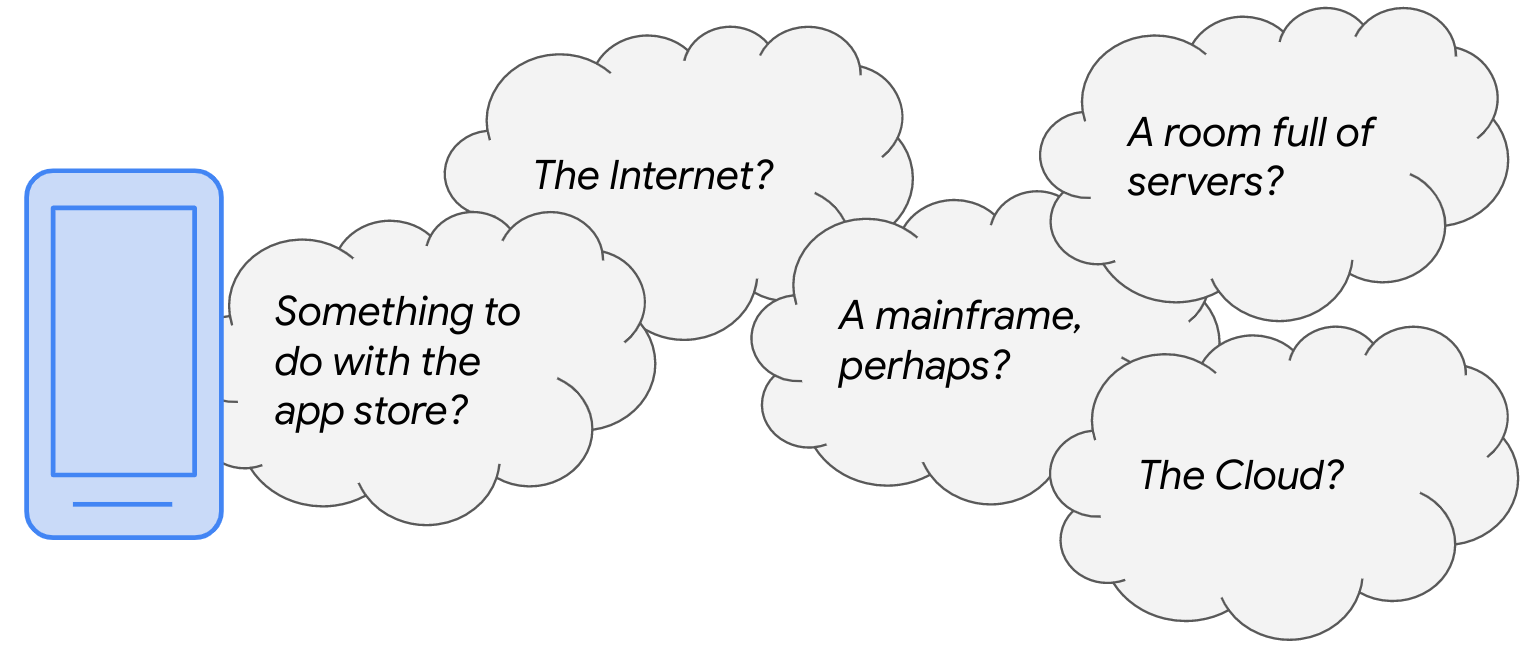
We started here:
And we ended here:
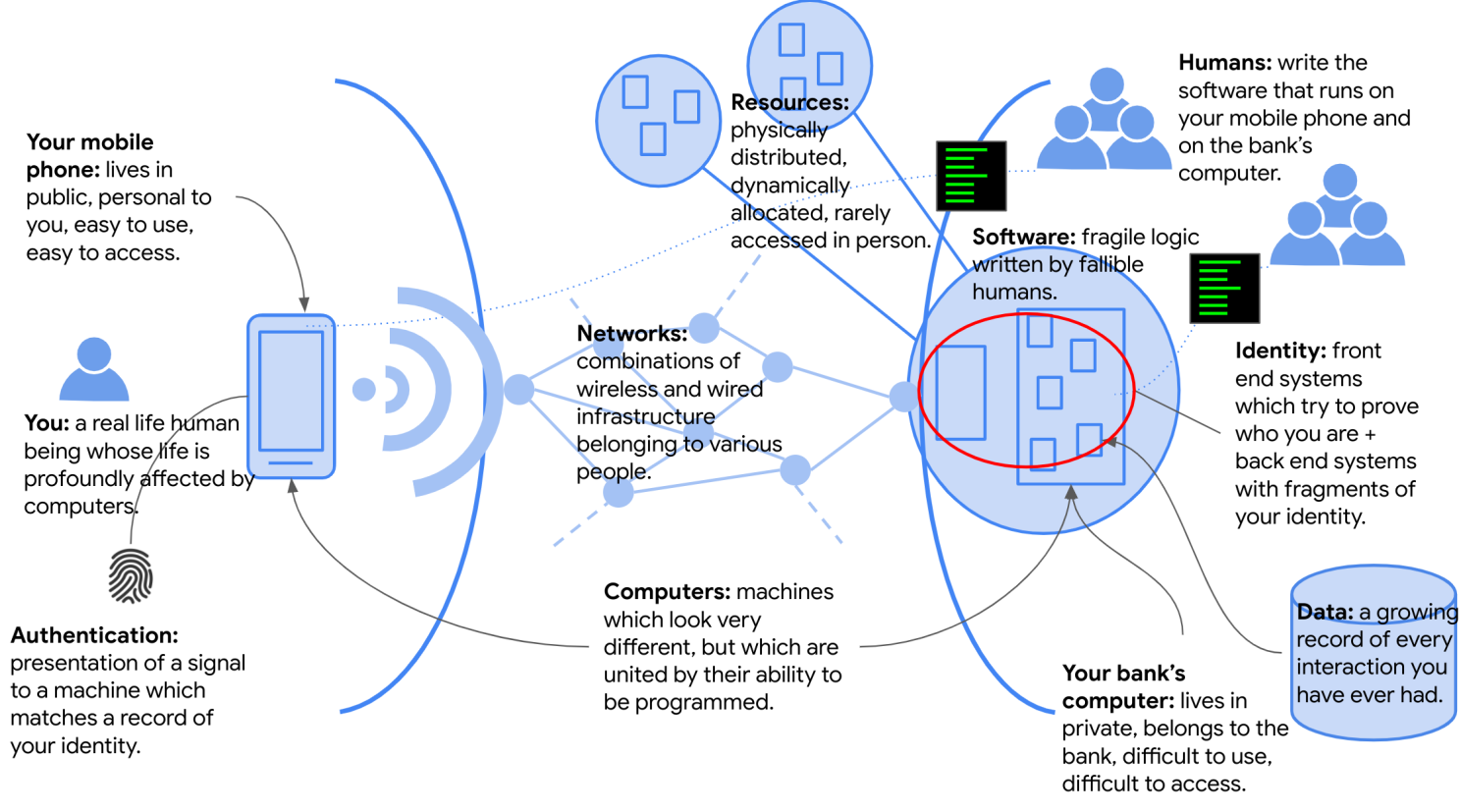
I was going to try to tidy this picture up, but I now think that its messiness, developed organically in a series of steps, is a good representation of how technology works, and how it grows.
