Can we see the future from here?
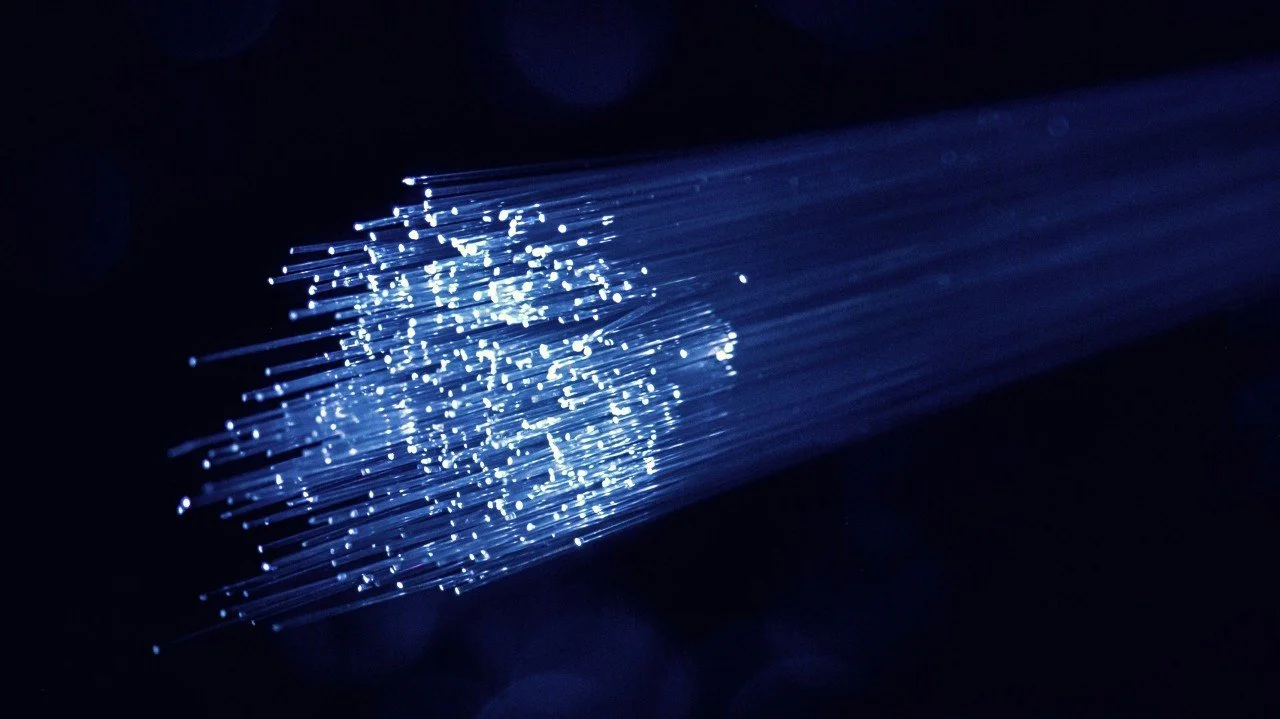
Photo credit: Denny Muller via Unsplash
After the Second World War, it was clear that the telecommunications infrastructure of many countries needed an upgrade. The digital computer had been invented, and was emerging from the lab into the economy. In the USA, the giant early warning and control system, SAGE (Semi-Automated Ground Environment) was being built to cope with the threat of nuclear war, and needed systems and sensors to be connected across the country. The old copper cables of the telephone and telegraph systems were not up to the job.
Fortunately, experts, researchers and engineers had a solution: they would use light to transmit information rather than pushing electrons through copper. However, they did not start with the flexible, glass optical fibres that we are familiar with today: they believed that glass could not be manufactured with sufficient transparency to carry light over long distances and that, even if it could, the photons would escape at the bends.
The best candidate for optical communication in the late 1950s was the microwave waveguide: a fibre glass tube four inches in diameter, lined with copper and filled with air. Microwaves would bounce down the tube, moving at the speed of light, allowing many simultaneous transmissions to be assigned to different frequencies. However, the tubes were big, expensive, and could only accommodate gentle curves, with a minimum radius of hundreds of feet.
Imagine how different the world would be if we had to rely on microwave waveguides instead of fibre optics. We might have these big tubes running under our streets or over our heads. Server rooms might look like the engine rooms of ships, and network engineering might seem more like plumbing than electronics. It seems unlikely that we would have ‘microwave to the door’, or even ‘microwave to the street’. The Internet would have grown more slowly and moved more slowly.
Fortunately, thanks to the work of researchers such as Narinder Singh Kapany, who coined the term ‘fibre optics’ and showed how light could be reflected inside curved glass fibres, and Charles K. Kao, who pioneered the practical development of fibres which could carry light over long distances, our network backbones are built out of materials which are flexible, durable and cheap. The microwave waveguide was abandoned before it became part of national or international infrastructure. (For a much better, clearer and more detailed version of this story, visit Richard Epworth’s site and make sure to watch the videos: https://opticalfibrehistory.co.uk/ .)
Why does this story matter today, other than informing us about the origins of our networked world? It matters because it reminds us that the future we imagine is based on what we understand today, not what we will know tomorrow.
If you look at pictures of big microwave waveguide tubes now, they look impossibly clumsy and unwieldy, and it seems obvious that they were a conceptual dead end. But it was not obvious at the time: those waveguides were seen as the frontier of advanced technology, developed by some of the smartest and most expert people in the world.
Today, we live at a time of dizzying technological advances. Artificial Intelligence may occupy centre stage, but developments in genetics, energy production and quantum computing are also leaping ahead.
There is a tendency (particularly on platforms such as this) to make strong, confident assertions about how each of these advances will change the world: ‘<x company> just destroyed <y company>!’; ‘<p product> just showed that <q technique is dead>!’; ‘<a model> version <b number> has completely changed the game!’). I think it is useful to think how these assertions would sound if they were made about technologies such as microwave waveguides: ‘The new four inch tube means that nothing will ever be the same!’; ‘We just need bigger tubes and more microwaves to transform things forever!’ and so on.
The fate of the microwave waveguide, and many other dead end technologies, shows us that, while it is fun (and occasionally scary) to predict the future, we are always looking at tomorrow from the perspective of today. Sometimes we will be right, but we should always be prepared to be wrong.
