What was I thinking?
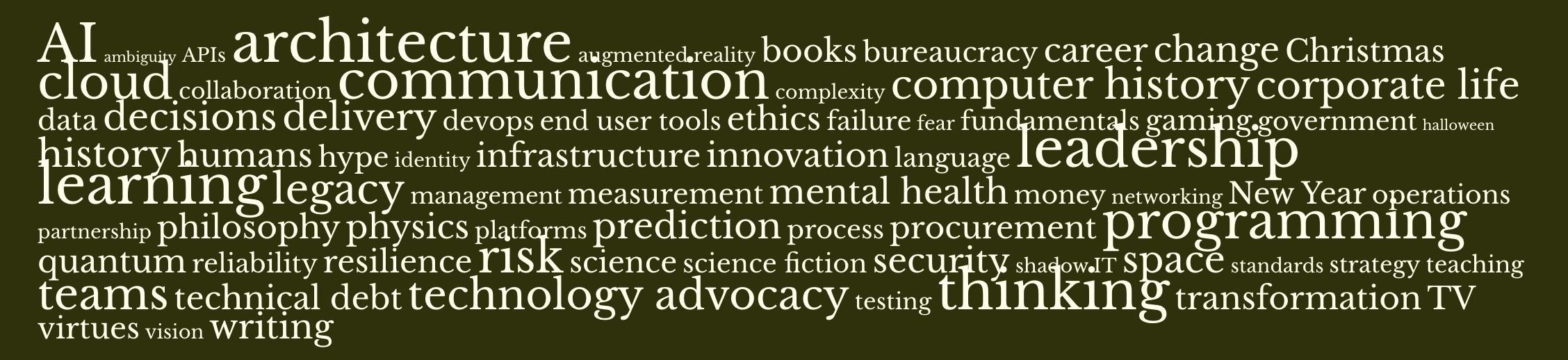
A few months ago, I decided to set up this blog site to hold all of the articles I have published on LinkedIn, whether in the A Lot to Learn newsletter or standalone articles from before LinkedIn used newsletters.
That might seem like a self-indulgent exercise, but I thought, first, that it might be useful, and, second, that, if it was useful, I might need a content lifeboat. Unfortunately, social media platforms tend to decay, and I anticipated that there might come a point in the future where I didn’t want to be on this platform any more. (I won’t comment in depth here about the quality of LinkedIn, other than to say that I have a mental threshold for the number of toxic, divisive posts I’m prepared to see, and, sadly, the content here increasingly approaches that threshold.)
Whatever the motivation, I found the process of transferring articles across to the new site interesting. I kept thinking that this is exactly the sort of busywork that I should be using AI to help with, but found that I enjoyed the process of reviewing what I had previously written and trying to figure out what I thought about it.
I particularly enjoyed the old-fashioned task of tagging articles. I had to make a few choices about which tags to use. Should I embrace buzz phrases (‘agile’, ‘devops’, ‘agentic’) or use ordinary English terms (‘thinking,’ ‘writing’, ‘leadership’)? I mostly tried to stick to the latter, unless the article was specifically focused on a topic where it made more sense to use the label. What term should I use to describe the process of creating software? ‘Development’? ‘Engineering’? In the end, I went with ‘programming’, because that’s what it was called when I learnt to do it on my first home microcomputer.
Once I’d finally been through nearly eight years of articles, the tags produced the word cloud shown at the top of this article. It’s not surprising that technical topics like AI, architecture, cloud and programming feature prominently: while I’ve been writing these articles I’ve been a Chief Architect, worked for a cloud company, lived through an explosion in interest in AI, and carried on writing code. The pattern of these topics over time may tell us something more interesting, though:
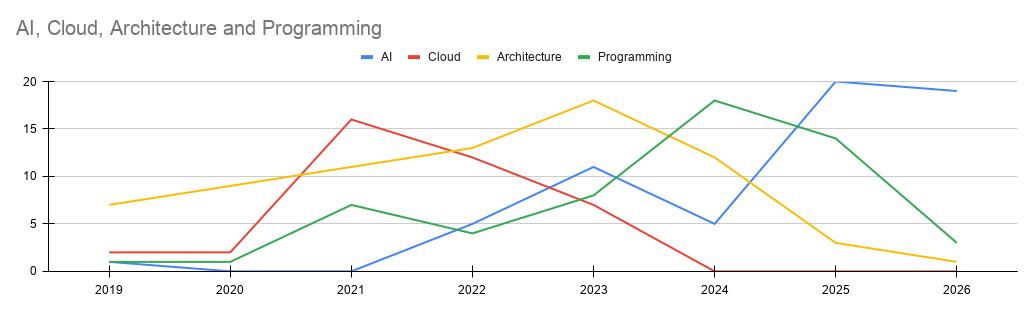
You don’t need an AI model to predict the increasing frequency of articles about AI. But I didn’t realise that, although I continue to be a big advocate for cloud, I seem to have stopped writing about it two years ago. Perhaps this is because I subconsciously felt that cloud didn’t need so much advocacy any more: it had become an accepted and normal part of the technology landscape. With the current focus on digital sovereignty, though, I have a feeling that I will find myself thinking, talking and writing about cloud again in the near future.
I was also intrigued to discover that I had to create lots of tags to cover less technical topics: ‘leadership’, ‘communication’, ‘thinking’ and ‘learning’. (Perhaps that last one should have been obvious, as my newsletter is called, ‘A Lot to Learn’.) There are some interesting patterns over time for these topics too:
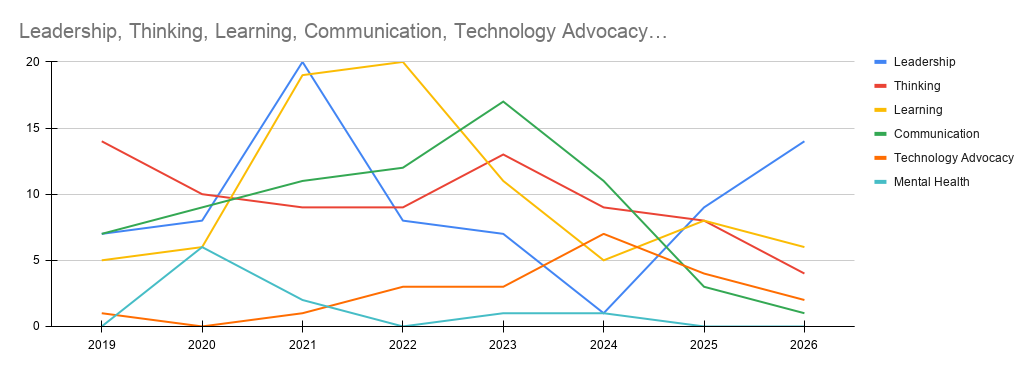
Apparently, thinking and communication were my top priorities in 2023, which also happened to be my first year in a technology leadership role in government, a role which tested and stretched my abilities to think and explain. And leadership and learning were both priorities in 2020, a year when we had to adapt to leading remotely, and had to learn ways of working which we had never anticipated. 2020 and 2021 were also years were learning was a solace and an escape.
There are a couple of other topics which have crept onto that chart. I knew that I had written a couple of times about mental health in 2023 and 2024, and both times it felt like it was the first time: who was I to express opinions on such an important but sensitive topic. But when I look back at 2020 and 2021, I realise that I wrote about mental health times a few times then too, about feelings of isolation, disconnection and uncertainty. I just didn’t give it that label.
And I have apparently felt moved several times over the years to write in a voice to which I have given the label, ‘technology advocacy’. I used this voice when I felt that technical experts were misunderstood or ignored. Such advocacy might seem unnecessary in a world where leaders of technology companies are rich and powerful, and where their voices command plenty of attention (even when they are talking way outside their areas of expertise). However, while those people don’t need advocacy, I do think that the people working in IT departments, trying to keep systems going, patching up legacy, delivering projects, explaining what’s possible and what’s not, debunking hype, defending against cyber attacks and, today, facing threats that they are all going to be replaced by AI, deserve recognition and respect.
I’m going to keep publishing on LinkedIn for now, but will also publish here and we’ll see what new tags bloom in the word cloud.
