A suggested New Year’s resolution: don’t let bad formatting hide good ideas
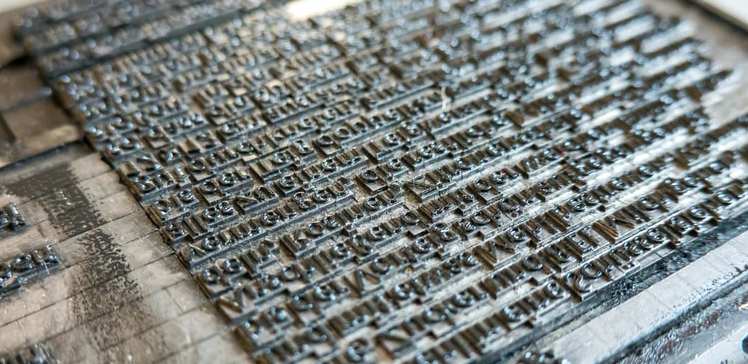
My parents gave me many gifts: a loving home and all the support I could ask for. There is one gift, though, which they didn’t plan: a low tolerance for poorly formatted documents, to an extent which has enabled me to irritate every team which has ever worked for me throughout my career.
This started back in the 1980s, when my Dad, who sold print and reprographic equipment, had two realisations. First, he spotted that the shift from hot metal (blocks of lead type set by hand) to phototypesetting (photographic images of type produced electronically) was an inevitable trend. Second, he realised that he’d far rather work for himself than for an employer. As a result he and my Mum founded a typesetting company based out of our home.
Growing up in the same house as my Mum and Dad’s typesetting business taught me many things. It showed me the evolution of a business through technology: as the years passed, I saw the equipment change from its original incarnation (an electric typewriter with an interchangeable ‘golf ball’ for different fonts, to produce paper copy physically cut and paste with scalpels and glue on a light table) through our first proper computers (green screens attached to big orange boxes, which still produced paper for the light table) to its first fully electronic form (Macs with giant screens that produced files(. I also saw the impact on businesses and ways of working: how the flow of motorbike couriers to pick up copy at any time of day and night (print was always a deadline driven business) slowed and stopped as they were replaced by file transfer and email (but still at any time of day or night).
As this was a small family business, everybody had to do their part: my pocket money job was proof reading, meaning that I spent part of my spare time scanning through brochures and magazines and menus and wine lists and all the other variety of material that came for setting, looking for mistakes.
And I think that’s what gave me my propensity to irritate my teams by giving them firm feedback on how their documents look, as well as what they say.
Technology architects have a strange relationship with the formatting of documents. These days, thanks to the collaboration technologies that form part of our architectures, we have access to capabilities far in advance of the set up which my Mum and Dad had when they founded their company - or even through all the years that they ran the business. Furthermore, architects have difficult and complex ideas to convey, and writing those ideas down and writing them well is a key part of their job: it projects those ideas into their enterprise in a way which is not limited by their physical presence, and it enables others to make use of their ideas. (That’s why communication mastery is one of the three attributes of Zang Jing Ge.)
And yet, many (but by no means all) technology architects routinely produce documents which are badly formatted, to the point where they look amateurish, and not just to my pernickety eye. Furthermore, many architects who produce such documents can’t see what is wrong with them, or, when they do realise what is wrong, don’t see why it really matters. As ever, I try not to blame those architects: this is evidently a skill and a habit which many people have not learnt.
I know that some people won’t agree with me that good formatting is important, and won’t see a reason to learn this skill and acquire this habit. In particular, they may point out that the culture of business is changing, that we are adopting the habits of companies led by software engineers, and that we should be less hung up on traditional enterprise concerns, such as worrying about font sizes and bullet points.
If you are one of those people, let me make the case for making learning good formatting one of your New Year’s resolutions.
It’s easier to read
Fancy formatting is not good formatting. I am not suggesting that you become a Powerpoint architect, and fill your slide decks with animations and graphics. In fact, I am suggesting the opposite.
Good formatting at its best is invisible: it enables a reader to engage with content without having their eye snagged by weird layouts and strange styling.
Consider the last time you really lost yourself in a novel. The medium of paper and print (or ereader) fell away, and you were in a world of your and the author’s imagination. Now consider how quickly you would have been pulled out of that world if you’d turned the page and found that the font had changed, or that the paragraphs were weirdly indented. This still sometimes happens on ereaders with books that have not been converted well, and, if you have tried to read such a book, you know how much hard work it is.
It helps your ideas compete fairly with others.
If you have worked for very long as a technology architect, you will have noticed that most people don’t just do what you say: they have plenty of ideas of their own, and there are plenty of others in the world (analysts, consultants, salespeople and many more) with alternative points of view they they want to promote.
And you can bet that those ideas are well formatted and professionally presented.
Sometimes those ideas are better than yours, and you should embrace and adopt them. But often your ideas are right, and they should not lose out just because they are poorly presented.
You might think that it is unfair and superficial of decision makers to be swayed by formatting, but you must remember that even the most senior decision makers are human too, and that if they don’t understand your ideas, it’s your problem, not theirs.
It shows that you are a professional
As technology architects, we are privileged to design architectures, products and systems which serve our customers and our business. We are trusted with multi-million dollar decisions which may directly impact the lives of millions. We put together complex technologies in complex ways to achieve these goals. We ask people to place their faith in our expertise and judgement.
We take our job title, architect, by analogy from architects who work with physical materials and physical construction projects - members of a respected profession with professional bodies, licensing and accreditations. If one of these professionals turned up to advise us on a building project with plans which were ragged, scrappy and stained, we would not trust them.
If you try to guide your company to make big decisions on the basis of documents which show that you either don’t care about or can’t see the most basic of formatting errors, why should your company trust you.
Of course, if your are persuaded, you may now want me to tell you how to learn good formatting. That’s harder, but will be the subject of my next blog post.
