A quantum of understanding - with a little help from some friends
Last week I shared that I was hitting a wall (made of maths) in my attempts to understand quantum computing, but that learning new things about the wonder and weirdness of the quantum world was keeping me going. This week I have to admit that I was rapidly running out of wonder, with a lot of wall still to climb.
Fortunately, some people came to my rescue! I have to thank Daniela Mordetzki for introducing me to her brother, Ariel Mordetzki, a researcher in quantum computing, to Ariel for taking the time to talk to me, and to my old colleague Michel Allair for taking the time to write and share notes on his own exploration of this field. Together, they helped me get a grip on concepts and explanations which had been eluding me. They also helped me to understand why all the books I am trying to read about quantum mechanics dive into the mathematics so early: at this stage in the maturity of quantum computing, the maths is what it’s all about.
I learnt many more things than I have space to share here, such as the comparative state of quantum computing (similar to classical computing in the 1960s), and the potential threat to cryptography (theoretically real but practically distant). But the main lesson I learnt was a basic understanding of the significance of qubits compared to classical bits. Here is my attempt to express my current understanding in my own words, with some analogies that help me. I am sure that I will get some things wrong: please feel free to tell me when I do.
Let’s start at the beginning, with qubits. Based on the coaching I’ve received, my very limited, plain language understanding of a qubit is: an entity which, when measured, has a property which can be expressed as a binary value (1 or 0), but which, before being measured, does not have that value, but rather has a probability of having either of the two values. This means that the qubit carries more information than a one or a zero: it also carries those probabilities. But to figure out what the probabilities are, we must measure it many times. There are multiple possible entities which have the quantum properties to behave as a qubit (such as the spin of an electron or the polarisation of a photon), but I will those hardware questions for a future article.
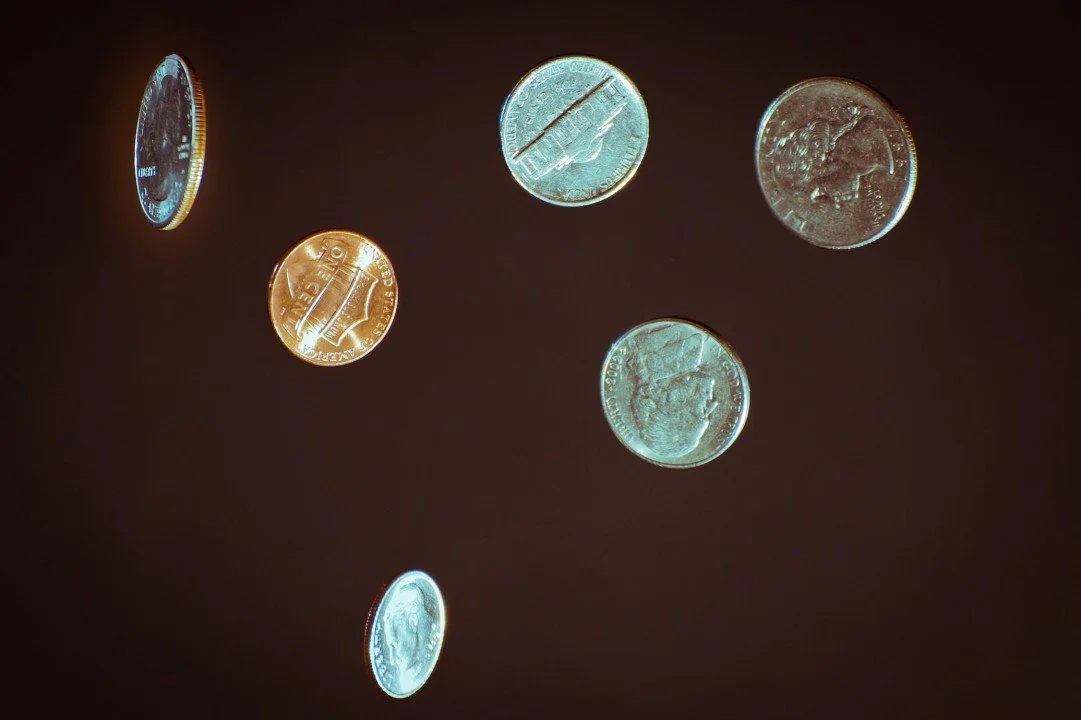
I have learnt that analogies based on non-quantum phenomena can be dangerous in this field, but here’s an analogy which is currently helping me understand why qubits might be interesting. Imagine that I have a coin. If I had a large number of these coins, I could place them all on a table in definite states of heads or tails: with a lot of time, space and patience, I could use them to build a very slow, manual classical computer. But if I flip the coin, its state is dependent on probability: for an ordinary coin, the chance of getting heads or tails should be equal.
Now imagine that I also have a trick coin, which is 75% likely to come up heads, and only 25% likely to come up tails (maybe I am a con artist, and I use this coin to make money off unsuspecting victims in bars).
Let’s take one of the coins and flip it. When it is in the air, the coin is neither heads nor tails: it doesn’t acquire that property definitively until I catch it. Flipping the coin once doesn’t tell me whether I have an ordinary coin or a trick coin. But if I flip it many times, then I discover new information: I discover how often it comes down heads or tails, and I can figure out which coin I have. Moreover, if I flip the coin often enough, I can figure out the probability of getting heads: 50% or 75%.
Now let’s imagine that I have a very large number of trick coins, all with different probabilities of coming up heads. Some will be near certain to be heads, while others will effectively never come up heads. I can find out which I have by flipping them enough times.
Why would such a system be interesting? Because each coin carries more than one bit of information (heads or tails): it carries information about the probabilities of it coming up heads or tails. Furthermore, if I have multiple coins, then I have even more information: I have information about the probabilities of the combinations they will produce. Apparently, that information can be expressed mathematically linear combination of vectors, and those vectors can be subject to mathematical operations If I set up the system of coins in a certain way, and apply certain algorithms to it, then I can create and solve interesting problems.
I am sure that this analogy will soon break down: I haven’t learnt enough yet about entanglement, but I suspect it will be hard to translate into images of flipping coins. I also have to admit that I don’t yet know enough to know what the interesting problems are, and how I would go about creating the quantum algorithms to solve them (I may never achieve that last part). But I am starting to understand why a quantum computer is fundamentally different from a classical computer: it enables operations on multiple pieces of information simultaneously. And that, I think, is why those books dive into vector mathematics so quickly: they’re not just using the maths to describe the entities and states which comprise quantum computers - operating using that maths is the whole point.
I’ve still got a long way to go, and I still have a lot of questions, but my experience this week has reminded me of the value of learning from people who are far further along this path than me - and who are generous with their time and expertise.
