Which are more dangerous: slides, or sticky notes?
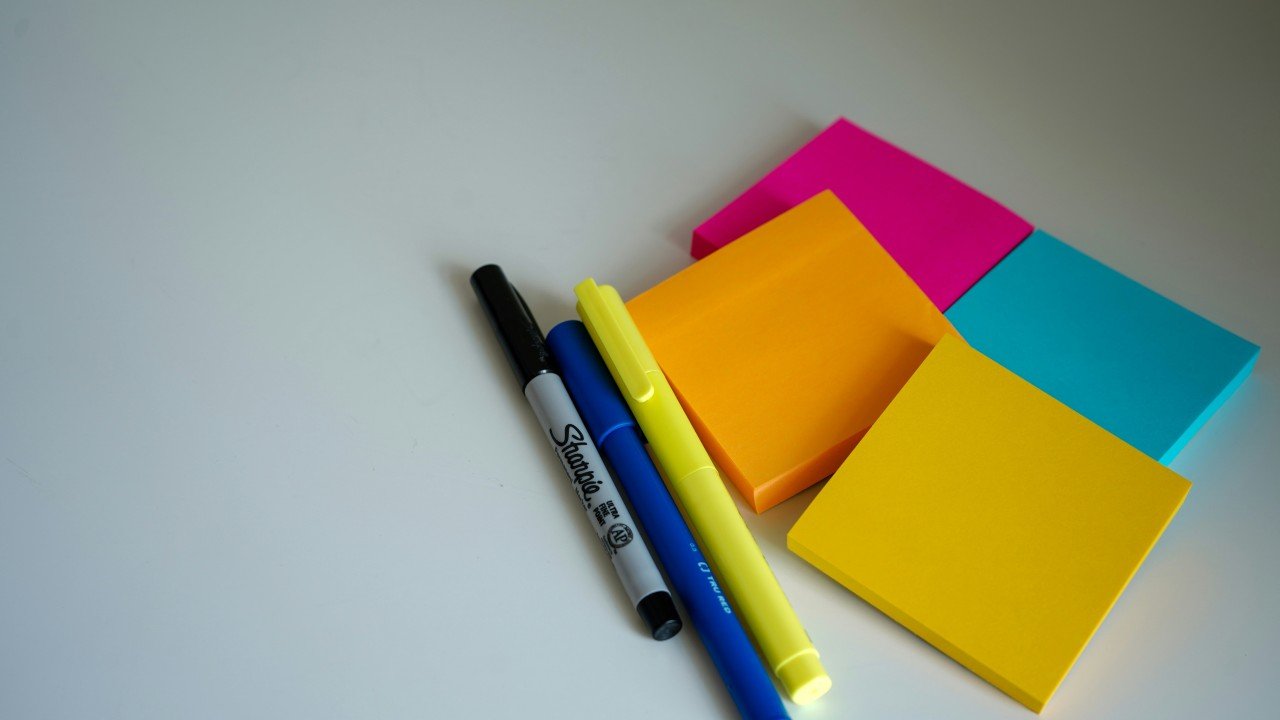
Photo Credit: Ravi Palwe via Unsplash
We’ve all been in that meeting. Perhaps you are planning a programme or designing an architecture. Perhaps you are working on the culture and performance of your team. Perhaps you are figuring out the implications of a new technology. And then it happens. The facilitator starts walking around the room distributing pads of sticky notes. Your heart sinks. Before you know it, you are split into groups and have ten minutes to write down your ideas and priorities on little coloured squares of paper, before you stand up and read them back to the room. You wonder what you will say this time. I don’t really have anything to add? Or, Sandra’s team really said it all?
We’ve also all been in the other meeting. The one where you have a twenty minute slot on the agenda to make difficult decisions on a complex topic. The one where everyone is more senior than you, and they will all be staring at the screen showing the slides that you have carefully prepared. You tried as hard as you could to squeeze the nuances of the topic onto each slide, but you needed to make ten points when you only had space for nine. And there was an important concept that didn’t fit into the elegant diagram. And you needed to distinguish between five types of idea, but your corporate palette only had four colours. You squished and squashed and squeezed your thinking until it fit on the slides. They don’t quite say what you want them to say, but you think you will get the decision that you need. And isn’t that what matters?
Of course, these portrayals are caricatures. Our workplace is full of tools, and most of these tools are useful, when used in the right way. The invention of sticky notes was famously serendipitous: a glue that doesn’t stick properly gives us something that we can attach to surfaces and move around. The invention of presentation software was an advance on transparencies, prints and flipcharts: we can change our slides, share them electronically and express ourselves using colour, graphics and charts.
However, these media impose constraints on the message - and on our thought.
The maximum amount of thinking you can fit on a sticky note is, well, all that you can fit on a sticky note. This typically means one to three words, written with a marker pen. You may try to fit more words on, but they will likely be illegible - and unlikely to be read out during the playback session. Sticky notes support brevity, speed and flexibility - but they do not support depth.
Superficially, slides appear much more flexible. They are blank communication surfaces, on which we can write as many words or place as many pictures as we like. We can go into depth, include numbers and add illustrations. We can even add animations to bring our message to life. In theory, slides are open to complexity and nuance. In practice, slides are a presentation medium, and writing for presentation imposes its own constraints, especially when the goal is to reach a decision. There is a strong temptation to craft slides that convince and persuade or sooth and reassure. Slides help guide people to a smooth consensus - but they struggle to precipitate conflict and debate, even when that is what is needed.
(There is, of course, also a whole world of detailed reports produced using presentation software, typically by consultants, which are effectively documents turned sideways. These have their own constraints and dangers which I may return to in a future article.)
The results of the constraints imposed by slides and sticky notes can be the opposite of what we intended. A breakout exercise using sticky notes may have the goal of engaging the audience and eliciting new ideas, but end up with the bored recitation of familiar concepts. A finely crafted presentation may have the goal of enlisting decision makers in the complexities of a difficult decision, but end up with superficial consent because the slides looked nice.
I do not think that we should stop using slides and sticky notes. Like all the other tools we have to hand, they have their place and they have their uses. We just need to think hard about what they are good for.
And we have much more of this thinking to do, as new tools enter the workplace. AI assistants promise to change our modes of working and communication even more profoundly than slides and sticky notes. I have already attended meetings where AI tools were used to capture and summarise the results of discussions. (Perhaps the stilted table by table playback is over?) In those cases the tools were helpful, but I was left wondering whether the AI summary constrained our thinking, or gave us more time to think (or both).
Using tools effectively means understanding how they work and what they are good for. That takes thought and practice - for new tools as well as old.
