Seven leadership roles for cloud transformation

I believe that small, empowered teams of skilled people are the best way to get things done. However, I also believe that there is still an essential role for leadership, especially in deep, enterprise wide transformation.
Moving to Cloud can be just such a transformation: an opportunity to change technology, culture and ways of working, as well as your relationships with customers, with data and with innovation. Transformation is delivered best by those small, empowered teams - but will go faster and be more successful if you have people who can play one of seven leadership roles:
These roles may not all be played by different people, and they may not be played by someone who is expert or experienced at them. And anyone playing them should remember that, however key that role is, and however important they believe themselves to be, like all leaders, they are there to serve others: all customers, all colleagues, and especially those people who use Cloud to deliver value - product managers, developers, operators and data scientists.
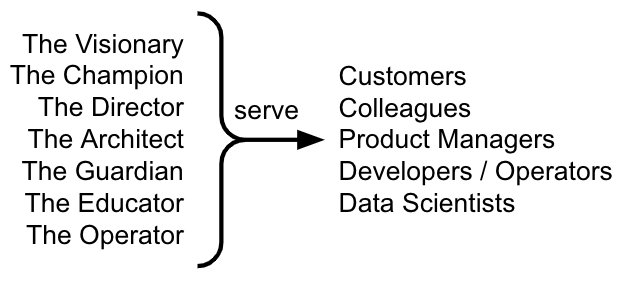
Here’s a quick summary of each of these roles:
The Visionary: the person who sets, expresses and explains the value that Cloud can deliver. The person in this role never stops seeing the vision, and never stops communicating it to others.
The Champion: the person who remembers the vision and objectives even when things get tough - and they will get tough. They anticipate and empathise with people who are sceptical, but figure out how to help those people to become advocates.
The Director: the person who knows how to get things done, even in a complex organisation which is stretching itself by trying to do new things. This person empowers others to deliver, partly by creating the conditions for them to succeed, and partly by getting out of their way whenever they can.
The Architect: the person who understands how the enterprise works today, how it will work in the future, and how things will change during the transformation. They prize clear thinking and clear communication; they are deep in technical domain knowledge and business domain knowledge.
The Guardian: the person who leads in protecting their customers, their colleagues and their enterprise. They understand and address the risks of Cloud - but they also understand when the use of Cloud is the best way to address risk.
The Educator: the person who realises that Cloud requires a change in culture, mindset and skills, and regards it as their job to help people acquire them. They have a passion for learning and for helping others learn.
The Operator: the person who makes sure that the use of Cloud in their enterprise is well managed, stable, resilient and cost-effective. They understand that the role of Cloud operations is to be prominent when helping others to get started, and invisible when others can confidently serve themselves.
It takes more than seven roles and more than seven people to deliver profound, wholehearted transformation. But you’ll get there faster if you understand and fill these roles. Over the following seven weeks, I’ll explore each of these roles in more detail, attempting to explain why they’re needed, what they do, and how people who play them can be successful.
