Innovation as application: a murmur from the mumble-tank
What was that?
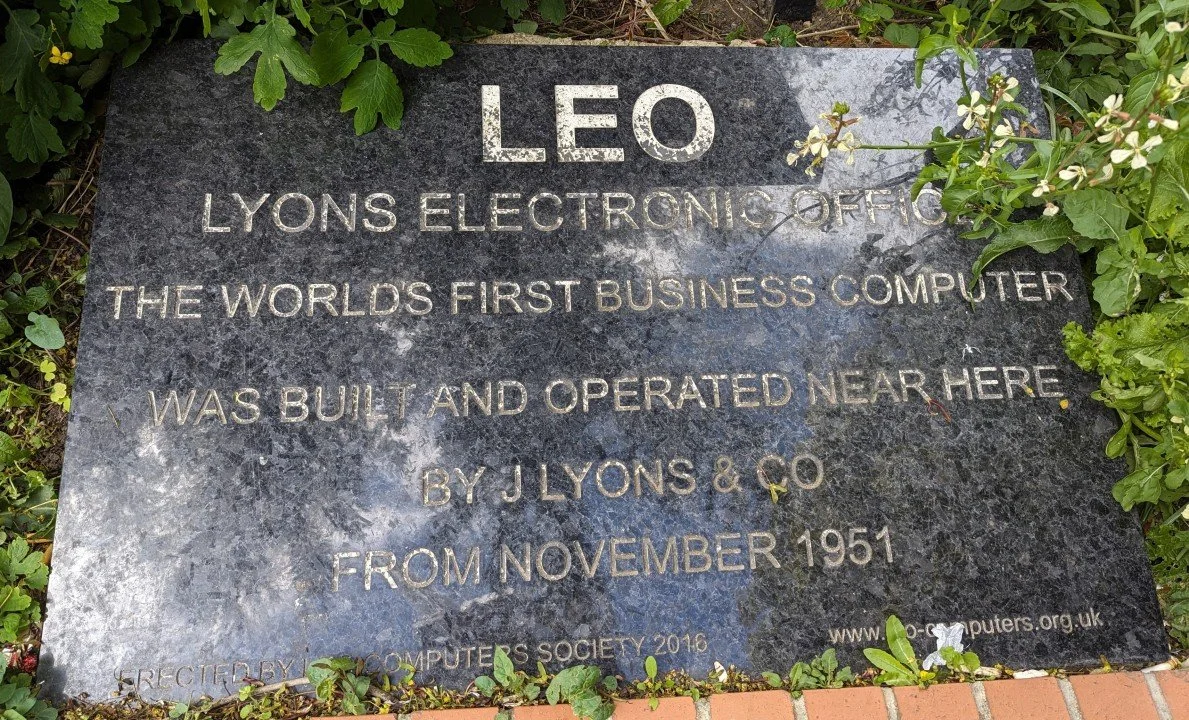
A modest stone plaque on a street corner, part overgrown with leaves. My wife and I were heading home from an exhibition at Olympia when we spotted it.
LEO
LYONS ELECTRONIC OFFICE
THE WORLD’S FIRST BUSINESS COMPUTER
WAS BUILT AND OPERATED NEAR HERE
BY J LYONS AND CO
FROM NOVEMBER 1951
I had heard the name LEO, and knew that it was something to do with early computers, but I don’t know much more. Fortunately, there was a much more detailed sign a few steps away. And, of course, we always have the Internet.
I quickly learnt that LEO was, indeed, the world’s first business computer, developed from the EDSAC machine developed at Cambridge, for Lyons and Co, the famous tea house and catering company. I also learnt that, like many early computers, LEO had some features which seem very peculiar from the perspective of 2024.
Take LEO’s temporary storage, for example. It was built long before silicon chps, when the problem of how to retain a stable but updatable representation of a piece of binary data had not been definitively solved. Paper tapes and punched cards were good for long term storage, but it’s hard to unpunch a card.
The EDSAC and LEO solution was to use a technique known as the mercury delay line. This involved a tube of mercury into which a pulse of ultrasonic sound waves would be injected by a pulsating crystal. When the sound waves were received at the other end of the tube, they would be converted by another crystal into electronic signals and sent around the loop again. Because the speed of sound varies according to temperature, the mercury was kept warm, at a constant 40 degrees Celsius. And, because the sounds made by the setup sometimes resembled human speech, it was known as the ‘mumble-tank’. (More technical terms like this, please.)
Data centres can be eerie places today: dark, cold and quiet, lights blinking in the darkness. But imagine how much more strange working with the LEO storage unit would have been, in a hot room full of tubes full of poisonous metal, mumbling and murmuring as the data circles continuously, turning from sound to current and back again.
Stories of early computers such as LEO often inspire through their ingenuity and improvisation. Living, as we do, in a world of semiconductors, could we ever imagine using sound waves in mercury as a medium of storage?
However, despite the intriguing physical engineering features of LEO, the truly inspiring story is one of innovation through application. The instigators of the LEO project saw the potential of automated calculation and how to apply it to their business. Once the physical engineering problems were sufficiently solved, they put LEO to work to calculate the costs of goods being produced in the Lyons bakery. And they found that, as expected, the computer was faster and more accurate than human calculation. Soon, LEO was calculating the payroll for Lyons, and then for other companies too. It has not taken many decades to reach the point where it is hard to imagine a business that could run without a computer.
The value of computing relies on fundamental insights and inventions: the creation of silicon chips, the definition of networking protocols, the development of architectures such as the transformer models which underpin the current explosion of interest in generative AI. However, the value of computing also depends on the ways in which we put these insights and inventions to work. That is the true innovation of the Lyons team, and a good reason for them and their computer to have a plaque - even if it is a little overgrown.
